

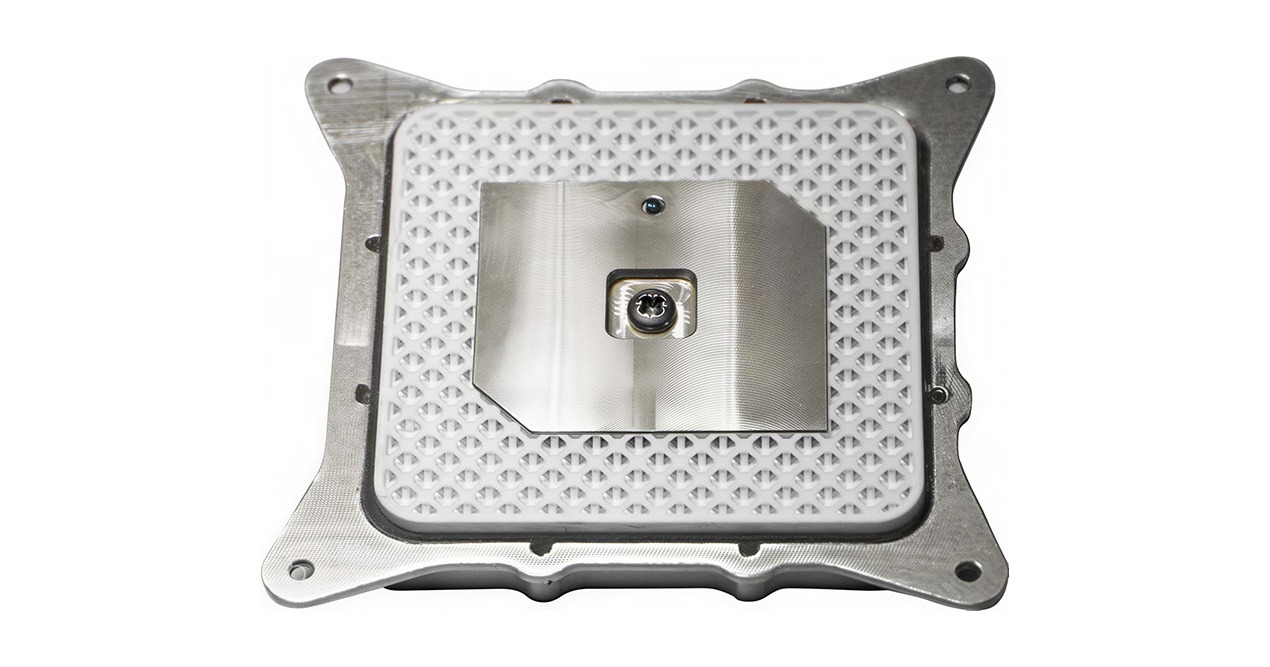
Ceramic 3D printing in aerospace – antennas with weight-optimized design
Ceramic 3D printing is becoming increasingly important in the aerospace industry. Additively manufactured ceramic components that have to withstand extreme conditions are used in satellites in particular. In addition to outstanding mechanical properties, the technology offers a decisive advantage: it significantly shortens the development process from the initial idea to the finished product.

From polymers to high-performance ceramics
The origins of 3D printing date back to the 1980s. Initially, the technology was limited to the processing of polymers. As the demands on materials increased – particularly in terms of thermal stability, chemical resistance and mechanical performance – new classes of materials were developed. Technical ceramics increasingly came into focus and significantly expanded the possible applications of additive manufacturing.
Ceramics in the aerospace industry
Technical ceramics are predestined for applications under extreme conditions. In the aerospace industry, they are used for heat protection systems, turbine parts, antennas and mirror mounts, among other things. A key advantage: even under high thermal stress, ceramics show only minimal geometric changes due to expansion – a decisive factor for applications in space.
Zirconium oxide – a key material
Zirconium oxide is one of the most promising materials for the aerospace industry. It is characterized by low thermal conductivity and is therefore ideal for thermal protection applications such as turbine blade coatings. In addition, zirconium oxide offers high thermal shock resistance and is less brittle than many other ceramic materials.
Advantages of SLA technology for zirconium oxide
3DCeram’s SLA technologies enable the processing of a wide range of oxide and non-oxide ceramics. In the stereolithography process, fine ceramic powder is homogeneously mixed in a light-sensitive resin – the so-called slurry. The material is then cured layer by layer using a UV laser.
This results in high-density components with high resolution and surface quality that are ideal for demanding applications.
The manufacturing process begins with the printing of a so-called green compact, which is then compacted into a dense ceramic component in a subsequent sintering process. In contrast to conventional processes such as pressing or machining, no tools are required. This ensures maximum design freedom, increased flexibility, lower costs and faster iteration cycles.
Innovation project: 3D-printed antenna made of zirconium oxide
As part of a development project between 3DCeram and Anyways, an innovative start-up and CNES spin-off, a zirconium oxide antenna was developed for small satellites.
The aim was to create a high-performance antenna with an optimized lattice structure in order to achieve outstanding high-frequency properties. The development process benefited significantly from additive manufacturing: A functional prototype could already be produced after the initial design draft.
The design was gradually optimized through iterative adjustments – both to the geometry and the printing parameters – as well as continuous customer feedback. The result: a significant reduction in development time compared to conventional production methods. It took around 18 months from the initial concept to the functional antenna.
Click here for the case study.

Conclusion
Driven by new materials and their certification, additive manufacturing is increasingly becoming a key technology in the aerospace industry. Ceramic materials offer decisive advantages, particularly for applications with high thermal requirements.
In addition to significantly shortening development times, 3D printing primarily opens up new degrees of freedom for innovations. Companies can develop, test and optimize faster – a decisive competitive advantage in a technologically highly dynamic industry.
You want to learn more about 3D ceramic printing in the aerospace industry? Please contact us here.