

Precision Engineering and Micro 3D Printing: Why Resolution Alone Isn’t Enough
When engineers talk about precision engineering, they are referring to the design and manufacture of components with extremely tight tolerances and the highest level of dimensional accuracy. The American Society of Precision Engineering (ASPE) defines the field as a discipline concerned with the design, development, and manufacture of high-precision components, instruments, and machines.
But what exactly does “high precision” mean in concrete terms? And can micro 3D printing actually meet the demands of precision engineering? To answer that, it’s worth clearly distinguishing between a few key terms.
Accuracy, precision, and tolerance: three different things
In everyday language, accuracy and precision are often used interchangeably. In metrology and manufacturing, however, they are fundamentally different concepts.
Accuracy describes how close a measured value is to the actual target value. If a part is supposed to be 100 mm long but measures 125 mm, the printer that manufactured it is not accurate.
Precision, on the other hand, refers to repeatability. A printer that produces 50 identical parts, all measuring 125 mm (instead of the required 100 mm), operates with precision but not accuracy. Conversely, a printer may produce different values with each print, which on average approach the target value but vary widely when considered individually. In this case, it would be accurate but not precise.

Tolerance links both concepts to practical application: it specifies how much deviation from the nominal dimension is acceptable in a specific application. A deviation of 1 mm may be irrelevant for a machine housing. For an optical lens or an electronic connector, however, it can render the component unusable.
Macro and Micro: Why Scale Changes Everything
Whether a component is “precise enough” always depends on the scale. A component measuring 101 mm instead of 100 mm has a deviation of 1%. A component measuring 101 µm instead of 100 µm also has a deviation of 1%, but on a completely different scale: a micrometer is a thousand times smaller than a millimeter. For comparison: a human hair measures about 70 µm in diameter.
Conventional 3D printers operate in the macro range. Their layer thicknesses are typically between 50 and 100 µm, and the tolerances they can achieve range from ±100 µm or more. This is sufficient for many applications. However, it is not sufficient for precision engineering, where tolerances of ±10 to ±25 µm are required.
This is exactly where micro 3D printing comes in.
Why traditional methods are reaching their limits
Until now, engineers in the field of precision engineering have primarily had two manufacturing processes at their disposal: precision machining (CNC micro-milling, micro-drilling, wire EDM) and precision injection molding (micro-injection molding).
Both methods produce excellent results but have known limitations. Precision machining is often not feasible for complex three-dimensional geometries with internal structures. Precision injection molding requires expensive tools and long lead times, making it uneconomical for prototypes and small production runs. And both processes increasingly reach their physical limits for feature sizes below 200 µm.
Anyone looking to use additive manufacturing in precision engineering therefore needs a 3D printer that can not only reproduce fine details but also operate with accuracy and precision. At best, most 3D printers meet only one of these three requirements.
Micro 3D Printing with PµSL: Resolution, Accuracy, and Precision in a Single Process
With its patented PµSL (Projection Micro Stereolithography) technology, Boston Micro Fabrication has developed a process that meets all three requirements simultaneously. Boston Micro Fabrication’s microArch printing systems achieve optical resolutions ranging from 2 µm to 25 µm with tolerances of ±10 µm to ±25 µm and a surface roughness of 0.4 to 0.8 µm Ra. What distinguishes micro 3D printing with PµSL from other additive processes is the combination of several factors. Unlike conventional stereolithography (SLA), which guides a single laser beam point by point across the surface, PµSL uses a DLP light source to expose an entire layer simultaneously. This ensures uniform curing and reduces internal stresses. At the same time, Boston Micro Fabrication uses a high-precision motion platform and advanced calibration algorithms that ensure each layer is positioned exactly where it belongs.
The result: micro 3D-printed components that rival precision injection molding and CNC micro-milling in terms of dimensional accuracy, surface finish, and reproducibility. No tools, no setup time—completed in hours instead of weeks.
Print resolution does not equate to component quality
A common misconception regarding micro 3D printing involves confusing print resolution with part quality. A printer can have a nominal resolution of 10 µm and still produce parts that deviate by 50 µm from the target dimension. Resolution describes only the smallest reproducible feature size, not the accuracy or precision of the overall part.
Boston Micro Fabrication addresses this issue by optimizing its microArch systems not only for resolution, but for the interplay of resolution, accuracy, and precision. Each system undergoes a comprehensive calibration process that ensures the printed components reliably meet the specified tolerances, print after print, component after component.
For which applications is micro 3D printing suitable in precision engineering?
Wherever small, complex components with tight tolerances are required, micro 3D printing is a viable alternative to conventional methods. Typical fields of application include medical technology (surgical instruments, catheter components, diagnostic devices), electronics (miniaturized connectors and sensor housings), optics and photonics (microlenses, waveguides, alignment structures), microfluidics (lab-on-a-chip, flow sensors, diagnostic chips), as well as research and development at universities and research institutes.
This technology is particularly valuable in phases that require rapid iteration: prototyping, design validation, pilot production runs, and clinical trials. In all these scenarios, micro 3D printing eliminates tooling costs and reduces lead times from weeks to hours.
Buying a Micro 3D Printer: Which System Is Right for Your Application?
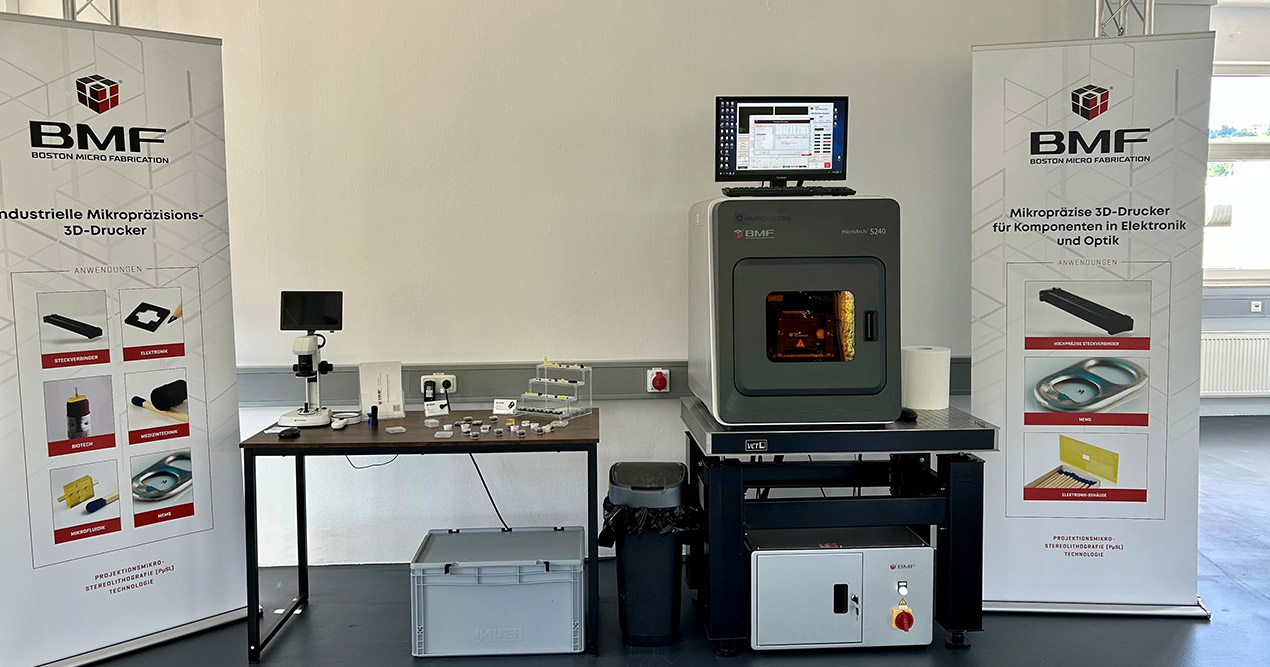
Anyone looking to buy a micro 3D printer faces the question of which system offers the right balance between resolution, build volume, and speed. Boston Micro Fabrication offers several options with its microArch product line: the S230 with 2 µm resolution for maximum detail accuracy, the S240 with 10 µm resolution for a good balance between precision and part size, the compact S150 Series with 25 µm resolution and one-touch operation for labs and development teams, as well as the D1025, the world’s first dual-resolution system that combines 10 µm and 25 µm in a single print job.
Which system is the right one depends on the specific requirements: How fine are the required structural details? How large do the components need to be? How many iterations per week are planned? What materials are needed?
Buy Micro 3D Printers in Germany: In-Person Consultation and Access
Anyone looking to purchase a micro 3D printer in Germany, Austria, or Switzerland will find AM Pioneers to be an experienced local partner. As an authorized Boston Micro Fabrication dealer in the DACH region, we offer the full range of services: from initial consultation and feasibility analysis to benchmark components on the appropriate system, as well as installation, training, and ongoing support.
At our Technology Center in Esslingen am Neckar, you can see the microArch systems in action and test your own designs on the printers. Even if you’re not yet ready to purchase a micro 3D printer, we’d be happy to produce your parts as contract prints using our in-house equipment.

Are you interested in exploring the possibilities of micro 3D printing for your precision engineering application? We can help you find the right solution. Contact us for a consultation or a free benchmark component.

Erik Nitsche
Sales Engineer BMF
+49 162 764 2630
erik.nitsche@am-pioneers.com