

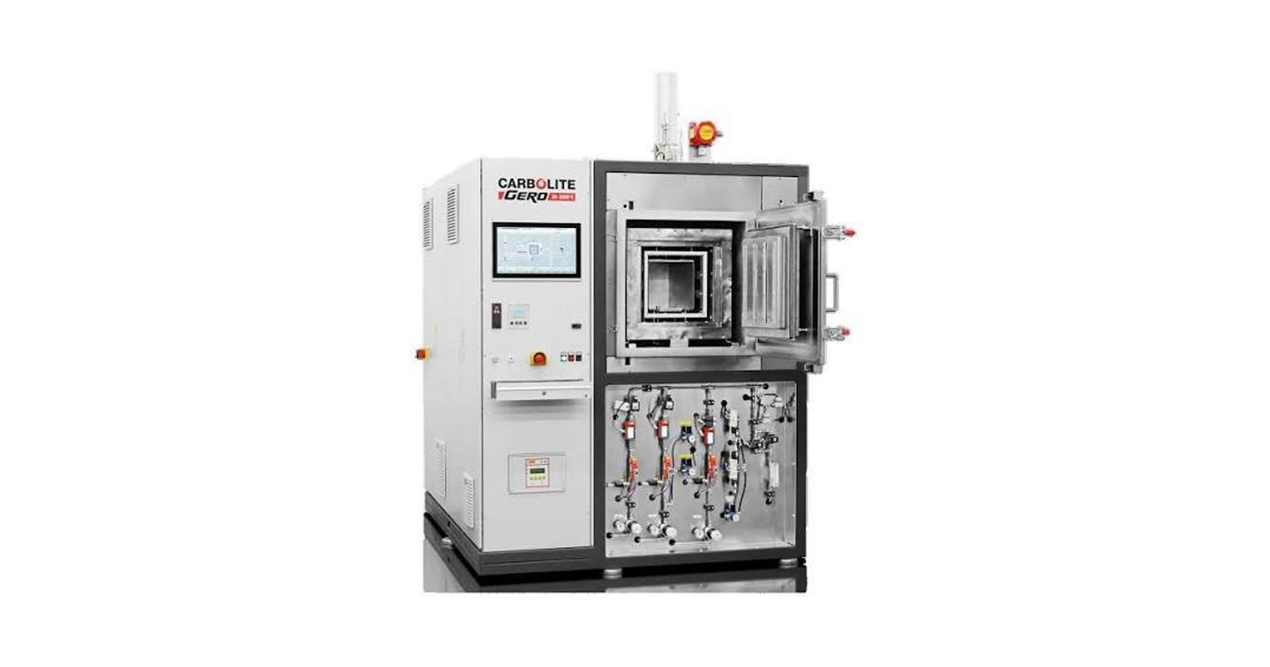
Why We Bought the Carbolite Gero HTK 8
And why it’s the perfect match for the Desktop Metal InnoventX
Anyone conducting research, development, or qualification work in binder jetting will sooner or later ask the same question: Which sintering furnace is right for my system? Here at AM Pioneers, we’ve given this question a lot of thought—and by 2025, we’d arrived at a clear answer. In this post, we’ll explain why we chose the HTK 8 from Carbolite Gero and how it forms a powerful, complete process chain with our Desktop Metal InnoventX.
The starting point: The Desktop Metal InnoventX as an open research system
The InnoventX is the most widely published research platform for binder jetting worldwide—used at institutes such as Fraunhofer IFAM, Fraunhofer IKTS, Offenburg University of Applied Sciences, IFW Jena, and other renowned institutions.
What sets the InnoventX apart is its open material and binder platform: More than two dozen metals, ceramics, and composite materials can be processed—ranging from 316L stainless steel to nickel-based alloys and titanium, to refractory metals such as molybdenum and non-oxide ceramics such as silicon carbide (SiC).
This diversity of materials is the key reason why we selected the InnoventX for our technology center in Esslingen.
Key Technical Specifications of the InnoventX
- Build volume: 160 × 65 × 65 mm (0.7 liters)
- Piezoelectric print head with 256 nozzles
- Layer thickness: 30–200 µm (depending on material)
- Build rate: up to 54 cm³/h
- Triple ACT® technology for a homogeneous, dense powder bed
- Standard deviation of green part density < 1% at a print speed of > 150 mm/s
- Sintered densities: up to 98% achievable after sintering
- 4 binder systems: AquaFuse™, CleanFuse™, FluidFuse™, PhenolFuse™

The problem: The variety of materials requires the right furnace
This is exactly where the challenge begins. The InnoventX can process many different materials—but the requirements for the sintering process vary considerably depending on the material:
| Material | Sintering Temperature | Atmosphere | Special Features |
|---|---|---|---|
| 316L, 17-4PH stainless steel | approx. 1,350–1,380 °C | H₂ or N₂/H₂ | Standard process |
| IN625, IN718 nickel-based alloys | approx. 1,260–1,310 °C | Ar or H₂ | Susceptible to oxidation |
| Titanium Ti64 | approx. 1,200–1,300 °C | High vacuum | Extremely sensitive to oxygen |
| Molybdenum, TZM | approx. 1,800–2,000 °C | H₂ | Very high temperatures required |
| SiC, B₄C ceramics | approx. 1,700–2,200 °C | Ar or vacuum | Highest temperatures |
| Tungsten-based materials | up to 2,200 °C | H₂ | Refractory metal |
A conventional laboratory furnace with a temperature range of 1,200 or 1,400 °C would have severely limited our range of materials. We needed a sintering furnace that was just as flexible and powerful as the InnoventX itself.
The decision: The Carbolite Gero HTK 8
After a thorough evaluation, we chose the HTK 8 from Carbolite Gero. Carbolite Gero is one of the world’s leading manufacturers of laboratory and industrial furnaces. The HTK 8 is a high-temperature chamber furnace with metallic insulation made of tungsten or molybdenum—and it was precisely this metal construction that was the deciding factor for us.
Reason 1: Temperatures up to 2,200 °C—for the entire range of materials
The HTK 8 reaches temperatures of up to 2,200 °C. This is essential for us to truly cover InnoventX’s full range of materials—from 1,350 °C for standard stainless steels up to 2,200 °C for SiC ceramics—without having to switch systems.
Reason 2: Highest atmospheric purity through metallic insulation
The metallic insulation made of tungsten or molybdenum ensures exceptionally high purity of the protective gas atmosphere and enables the best achievable ultimate vacuum in its class—a ceramic-insulated furnace cannot achieve this.
This is crucial for our target materials: titanium oxidizes in the presence of trace oxygen, nickel-based alloys form tightly reducing oxides, and molybdenum and tungsten become brittle. Maximum atmospheric purity is not an option—it is a requirement.
Reason 3: Flexible process atmospheres—H₂, Ar, N₂
The HTK 8 can be operated under hydrogen, argon, or nitrogen atmospheres. Operation at partial hydrogen pressure is particularly relevant: H₂ as a reducing gas removes oxide layers from powder surfaces and leads to higher sintering densities. The HTK 8’s safety technology ensures that this operation is process-reliable and reproducible.
Reason 4: Active cooling for fast iteration cycles
In research, speed matters. The HTK 8’s active cooling enables sintering cycles of around 24 hours for standard materials such as stainless steel—including heating, holding, and cooling. This allows for multiple iterations per week in R&D operations.
Reason 5: 8-liter volume matches the InnoventX
The 8-liter usable volume is deliberately matched to the InnoventX’s build volume of 0.7 liters. For R&D projects involving small batches and varying materials, we don’t need an industrial furnace with a capacity of 50 or 100 liters. The HTK 8 is precisely designed for the throughput of an InnoventX operation—efficient without being oversized.
The Complete Process Chain at AM Pioneers
With the InnoventX and HTK 8, we have established a closed-loop process chain for binder jetting research and services:
- Printing: The InnoventX prints the green body. Triple ACT® ensures a homogeneous, dense powder bed with a standard deviation in density of less than 1%.
- B Depowdering:B The green part is depowdered in the powder station. The integrated powder recycling system recovers loose powder.
- Sintering in the HTK 8: The green part is sintered under a material-specific atmosphere and at a material-specific temperature. Sinter densities exceeding 98% can be achieved.
- Quality inspection with ZEISS GOM Scan 1: The finished component is scanned over its entire surface and compared to the target CAD geometry. The results are fed into Live Sinter™.
This cycle—printing, sintering, scanning, optimizing—is at the heart of our technology center. The HTK 8 is the thermal core of this cycle.
What this combination means for our customers
Material qualification for exotic alloys: Customers who wish to qualify new materials—from refractory metals to high-temperature ceramics—can test the entire process chain under real-world conditions at our facility.
Research services: Universities and research institutes that require access to a complete binder jetting setup will find InnoventX, HTK 8, and GOM Scan 1 to be a perfectly coordinated system.
Prototyping of complex components: For customers in the aerospace, medical technology, or defense sectors who need prototypes made of IN718, Ti64, molybdenum, or SiC, we cover the entire process chain.
Sintering services: Companies that operate their own binder jetting system but do not own a high-temperature furnace can have their green parts sintered at AM Pioneers.
Conclusion: Not the cheapest stove—but the right one
The decision to choose the HTK 8 was not simply a matter of cost. There are less expensive sintering furnaces on the market—but no less expensive furnace would have been able to handle the full range of materials used by InnoventX.
For AM Pioneers, it was crucial to offer our customers an infrastructure that makes no compromises. The HTK 8 from Carbolite Gero is not merely an accessory to the InnoventX in this configuration—it is its equal partner.
Interested in a tour or sintering services?
Dann nehmen Sie gerne Kontakt auf – wir beraten Sie persönlich.

Frederik Nussbaumer
Head of Sales
+49 172 4059105
frederik.nussbaumer@am-pioneers.com