-

-
We are happy to advise you. Please contact our team for further information. info@am-pioneers.com


What AM Pioneers Offers in Ceramic 3D Printing
Ceramic 3D printing opens up new possibilities for the production of high-performance components: It enables the production of high-temperature-resistant, wear-resistant, and electrically insulating components with complex geometries that are difficult to produce using conventional methods—ranging from micro-precision individual parts to large-format mass-produced components.
With 3D ceramic printing, AM Pioneers offers cost-effective manufacturing solutions for demanding applications that push the boundaries of traditional ceramic manufacturing.
As a 3D printing reseller and manufacturing service provider based in Esslingen am Neckar, we use our state-of-the-art machinery to manufacture components using ceramic 3D printing—from prototypes to small-batch production and mass production.
In addition, we assist you in selecting and procuring the right equipment technology for your in-house production. From potential analysis and process design to on-site implementation, we guide you every step of the way toward a successful rollout of the technology.
A Comparison of Ceramic 3D Printing Methods
Processes available for this material at a glance — for a cross-material comparison, see our Process Finder.
| Procedure | System | Ideal for | Quantity | Delivery Time |
|---|---|---|---|---|
| Stereolithography (SLA) | C3601 ULTIMATE | High-precision, large ceramic components or mass production | 1– >1,000, depending on the component size | 4–6 weeks |
| Stereolithography (SLA) | C101 EasyLab | Small components, ideal for research and development | 1–10 | 4–6 weeks |
| Stereolithography (SLA) | C1000 Flexmatic | Larger components or small-batch production | 1– >500, depending on the component size | 4–6 weeks |
| PµSL Micro 3D Printing | S240 | Microfine Geometries | 1–1.000 | 4–6 weeks |
| Binder Jetting (SiSiC) | X160Pro | Large-volume mass-produced parts | 1–10.000+ | 4–6 weeks |
Ceramic 3D Printing: From Prototype to Production

Stereolithography (SLA)
UV-light-based process for oxide and non-oxide ceramics featuring a large build volume and high level of detail—suitable for complex functional geometries in 3D ceramic printing.
PµSL Micro 3D Printing
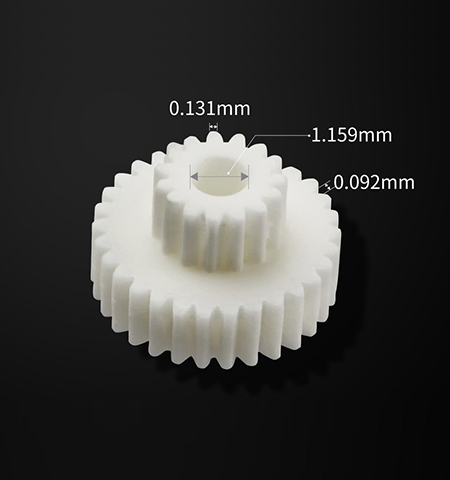
The highest-resolution process for ceramic microcomponents—used in applications where conventional ceramic manufacturing reaches its geometric limits.

Binder Jetting (Ceramics)
Sintering-based process for SiSiC — cost-effective for high-volume production and large-format components with high wear and temperature resistance.
Where 3D ceramic printing is already being used today
Aerospace
Radomes & Insulators
Process Engineering
Filters & Nozzles
Defense
Protective Ceramics
Where 3D ceramic printing is already being used today

Silicon nitride (Si₃N₄) combines low density with high strength, stiffness, and temperature resistance, making it ideal for demanding applications in the aerospace industry. Additive manufacturing enables the creation of complex, weight-optimized structures, such as lightweight and highly rigid mirrors for satellite-based optical systems .

Housings | AL housings for endoscopy require the highest precision, wear resistance, and dimensional accuracy, combined with very small and complex geometries. Ceramic micro-3D printing offers an optimal solution for this and enables the production of delicate components with tolerances of less than ±100 µm. Aluminum oxide (AL) stands out for its high hardness, biocompatibility, and chemical and thermal resistance.

3D-printed ballistic protection ceramics made of SiSiC using the binder jetting process combine extreme hardness and stiffness with low weight—and, thanks to additive manufacturing, open up design possibilities that cannot be achieved with conventional forming processes.
Material Portfolio
High-Performance Materials for Ceramic 3D Printing
Comparison of Materials: Mechanical Properties
Specifications according to the technical data sheets from 3DCeram/3DMIX (SLA materials) and the manufacturer's specifications for SiSiC (Binder Jetting).
| Criteria | Alumina | Zirconia 3Y | Zirconia 8Y | ATZ | Silicon nitride | Aluminum nitride | Cordierite | Hydroxyapatite | Tricalcium phosphate | Fused Silica | Silicore | SiSiC |
|---|---|---|---|---|---|---|---|---|---|---|---|---|
| Modulus of elasticity [GPa] | 300 | 200 | – | 220 | 290 | 368* | 140 | – | – | – | – | 330–440** |
| Flexural Strength [MPa] | 397 (4-Pkt.) | 950 (4-Pkt.) | – | 1.094 (4-Pkt.) | 881 (4-Pkt.) | 270 (4-Pkt.) | 150 (4-Pkt.) | 107 (4-Pkt.) | – | 16,7 (3-Pkt.) | 15,4 (3-Pkt.) | – |
| Impact Resistance | low (brittle, KIC ≈4 MPa·m½) | medium (high fracture toughness) | – | medium–high (chewy) | high (thermal shock-resistant) | low (brittle) | low (brittle) | low (brittle) | low (brittle) | low (porous ceramic casting core) | low (porous ceramic casting core) | low–medium (brittle, but good thermal shock resistance) |
| Hardness | 16,4 GPa (Vickers) | 12,6 GPa (Vickers) | – | – | – | – | – | – | – | – | – | 20–24 GPa (Vickers) |
| Density [g/cm³] | >3,9 | >5,95 | 5,79 | >5,2 | >3,13 | 3,22 | >2,5 | >1,5 | 2,47 | 1,36 | 1,77 | 3,0–3,1 |
| Thermal conductivity [W/m·K] | 23,3 | – | – | 5,4 | 23,6 | 163,1 | 3,8 | – | – | – | – | 150–175 |
Values according to technical data sheets from 3DCeram/3DMIX (as of 2018/2019); information provided by the manufacturer without warranty (“non-contractual data for reference only”). * Aluminum nitride: theoretical modulus of elasticity according to the data sheet. ** SiSiC: Modulus of elasticity depends on the free silicon content; operating temperature up to 1,380 °C according to manufacturer specifications. “–” = not listed in the data sheet. For binding values, see the respective material data sheet.
Frequently Asked Questions About Ceramic 3D Printing
When is 3D ceramic printing a better option than traditional pressing/sintering?
Additive manufacturing is particularly valuable in situations where traditional methods reach their limits: for complex geometries such as internal channels or delicate structures that would be difficult or very costly to produce using injection molds. 3D printing also demonstrates its strengths in short development cycles, as design changes can be implemented without new tools or long lead times.
Which process is best suited for the size of my component?
SLA is suitable for large, high-precision components; PµSL for microgeometries; and binder jetting for large-volume production runs of SiC/B4C. Our consulting services on ceramic 3D printing can help you make the right choice.
How do ceramic components behave at high temperatures?
Depending on the material, continuous operating temperatures ranging from several hundred to over 1,000 °C are possible—we provide material-specific advice tailored to your application.
How much shrinkage occurs during sintering?
Sintering shrinkage typically ranges from 15–20%, depending on the material, and is already accounted for in the design. With SiSiC, shrinkage is just 3–5% due to the infiltration of the green parts with liquid silicon. As a result, even large ceramic parts can be produced consistently using the binder jetting process—on our X160Pro system, which has a build volume of 800×500×400 mm, we offer the production of such components as a service.
Request a consultation on plant technologies or parts
Upload your drawing—our team will get back to you within 24 hours with a technical assessment.