-

-
 We are happy to advise you. Please contact our team for further information. info@am-pioneers.com

What AM Pioneers Offers in Plastic 3D Printing
At AM Pioneers, plastic 3D printing covers the widest range of processes—from micro-precision functional parts to large-format housings made of high-performance polymers such as PEEK or carbon-PEEK.
Applications range from simple decorative elements to sophisticated functional components designed for high-temperature environments, as well as micro-precision connectors and medical devices. With the various technologies in its portfolio, AM Pioneers’ plastic 3D printing covers nearly every area of application.
As a 3D printing reseller and manufacturing service provider based in Esslingen am Neckar, we use our state-of-the-art machinery to manufacture components using the plastic 3D printing process—from prototypes and small-batch production to mass production.
In addition, we assist you in selecting and procuring the right equipment technology for your in-house production. From potential analysis and process design to on-site implementation, we guide you every step of the way toward a successful rollout of the technology.
A Comparison of Plastic 3D Printing Methods
Processes available for this material at a glance — for a cross-material comparison, see our Process Finder.
| Procedure | System | Ideal for | Quantity | Delivery Time |
|---|---|---|---|---|
| PµSL Micro 3D Printing | BMF microArch S240 | Micro-precision functional parts | 1–1.000 | 1–2 weeks |
| FDM | 3ntr, One+ 400 Xtreme | Large-format functional parts and prototypes | 1–100 | 1 week |
| DLP | Envisiontec, Elego | Prototype and production parts with outstanding surface finishes | 1–1.000 | 1 week |
Plastic 3D Printing—From Microcomponents to Enclosures

PµSL Micro 3D Printing
Resin-based printing process for intricate plastic and ceramic geometries — suitable for components that require tight tolerances, high dimensional accuracy, and a high-quality surface finish.

FDM
Filament-based process for stable functional parts and housings in larger sizes — also processes challenging materials such as PEEK. FDM is therefore one of the fastest 3D printing processes when it comes to large-format parts in small batches.
DLP
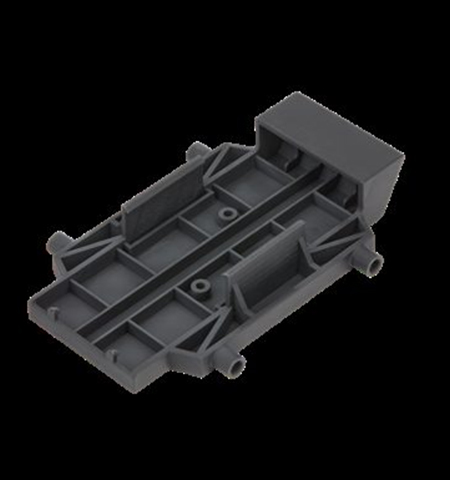
Light-based process for high-resolution parts with outstanding surface quality—ideal for design samples and functional prototypes.
Where Plastic 3D Printing Is Already Being Used Today

We manufacture connector plates for connectors using high-precision micro-3D printing with repeatable accuracy and tolerances of less than 20 µm. 3D printing offers economic advantages over injection molding, particularly for small to medium batch sizes and a wide variety of variants, as it eliminates tooling costs and allows for the flexible production of different designs.

Micro-3D printing enables the fabrication of microfluidic chips with internal channels up to 100 µm in size. The high resolution allows for reliable cleaning or rinsing of the intricate channel structures. A transparent material has also recently become available, offering new possibilities for applications that require visual monitoring of fluid flows and processes within the channels.

High-resolution micro-3D printing allows for the precise reproduction of microneedles with intricate structures down to 60 µm. The high degree of design freedom enables the geometry and penetration depth to be specifically tailored to the respective application. Conventional injection molding reaches its manufacturing limits, particularly when it comes to complex microstructures and very small features. Micro-3D printing opens up new possibilities here for the rapid development and tool-free production of sophisticated microneedle designs.
Material Portfolio
High-Performance Materials for 3D Plastic Printing
Comparison of Materials
Guidelines for the technical preselection of suitable plastics and photopolymers.
| Criteria | ASA | ABS | PACF | PEEK | Carbon-PEEK | TPU | Ultem | HTL | BIO | HT200 | TOUGH | SR | FR |
|---|---|---|---|---|---|---|---|---|---|---|---|---|---|
| Tensile Strength [MPa] | 40* | 25,3–29,2 | 138 | 89,9 | 136,0 | 40 | 98 | 71,5 | 56 | 87,8 | 82,9 | 38 | 68 |
| Elongation at break [%] | 20* | 5,52 | 1,71 | 4,7 | 2,2 | 400 | 5,2 | 7,8 | 6,2 | 4,6 | 14 | 26 | 5 |
| Modulus of elasticity [MPa] | 2.100* | 1.539 | 14.700 | 3.500 | 9.100 | 30** | 2.900 | 2.397 | 1.614 | 3.074 | 2.566 | – | 2.000 |
| Flexural Strength [MPa] | 65* | – | 100 (XY) | 116,0 | 144 (XY 45°) | – | 62,5 | 112,9 | 106,6 | 153,6 | 122,4 | – | 120 |
| Impact resistance [J/m] | 20* | – | – | – | 89,0 (Izod, gekerbt) | very high (no breakage) | 100 (Izod, gekerbt) | 30 | 15,5 | 14,5 | 18 | 114 | 18 |
| Hardness (Shore D) | 78* | – | – | 83,7 | 84,7 | 90 Shore A** | – | 81 | 84 | 78,6 | 74,5 | 60 | 85 |
Values for HTL, BIO, HT200, TOUGH, SR, and FR according to the material data sheets; PEEK, Carbon-PEEK, and Ultem according to the Roboze data sheets; ABS and PACF (Carbon PA) according to filament data sheets (ABS: Ultimate Tensile Strength 25.3 MPa or Yield Strength 29.2 MPa) — in each case, the strongest specified stress direction, 25 °C; values are partly dependent on the stress direction; for detailed values by orientation, see the material data sheet. Additionally, according to the data sheet for Carbon-PEEK: compressive strength 208 MPa (25 °C), coefficient of friction 0.24 (10 N), Poisson’s ratio 0.48; for PEEK: compressive strength up to 135 MPa (ZX, 25 °C); for Ultem: compressive strength up to 98 MPa, Poisson’s ratio 0.37; for ABS: density 1.05 g/cm³, glass transition temperature 75 °C, Vicat softening point 70 °C, decomposition temperature 300 °C; for PACF: density 1.4 g/cm³, heat deflection temperature (HDT) 180 °C @ 1.82 MPa, continuous service temperature 150 °C. * ASA (unreinforced) and other values marked with * are reference values from the literature; they do not refer to a specific product data sheet. ** TPU is a flexible elastomer and is specified in Shore A rather than Shore D, with a correspondingly low modulus of elasticity—therefore, it is only comparable to the other materials to a limited extent.
Frequently Asked Questions About Plastic 3D Printing
Which process is right for my plastic part?
This depends heavily on the specific requirements for the component: FDM is suitable for large, robust functional parts; DLP for fine patterns with a good surface finish; and PµSL for micro-precise geometries in plastic 3D printing. For a more detailed assessment, we’d be happy to schedule a personalized consultation.
Which plastics are suitable for parts subject to mechanical stress?
PEEK, Carbon-PEEK, ASA/PACF, and TOUGH offer high strength and temperature resistance for functional components in continuous use.
How soon will I receive a plastic prototype?
Depending on the process, delivery usually takes 1–2 weeks—we’ll provide the exact delivery time with your quote within 24 hours.
At what point does 3D plastic printing become more cost-effective than injection molding?
With no tooling costs, additive manufacturing is particularly cost-effective for individual parts, small production runs, and iterative development phases. Plastic 3D printing is also a good alternative for complex geometries that cannot be produced using injection molding.
Request system consultation or parts
Upload your drawing—our team will get back to you within 24 hours with a technical assessment.