-

-
 We are happy to advise you. Please contact our team for further information. info@am-pioneers.com

What Metal 3D Printing Does at AM Pioneers
At AM Pioneers, metal 3D printing delivers durable, functional parts with a density and strength comparable to those achieved through traditional metal injection molding (MIM). The spectrum ranges from rapid in-house prototyping to cost-effective series production of complex geometries.
Typical applications for metal 3D printing include tools and tool inserts, heat exchangers with internal channels, as well as technical mounts and replacement parts where traditional manufacturing methods reach their limits. At AM Pioneers, metal 3D printing covers the entire spectrum, from individual parts to industrial-scale production runs.
As a 3D printing reseller and manufacturing service provider based in Esslingen am Neckar, we use our state-of-the-art machinery to manufacture components using metal 3D printing—from prototypes and small-batch production to mass production.
In addition, we assist you in selecting and procuring the right equipment technology for your in-house production. From potential analysis and process design to on-site implementation, we guide you every step of the way toward a successful rollout of the technology.
A Comparison of Metal 3D Printing Processes
Processes available for this material at a glance — for a cross-material comparison, see our Process Finder.
| Procedure | System | Ideal for | Quantity | Delivery Time |
|---|---|---|---|---|
| Metal Binder Jetting | InnoventX · Shop System · X25Pro · X160Pro | Mass-produced parts, MIM replacements | 1–10.000+ | 2–4 weeks |
| Bound Metal Deposition | Studio System | Prototypes | 1–1.000 | 1–2 weeks |
Metal 3D Printing for Prototypes Through to Mass Production
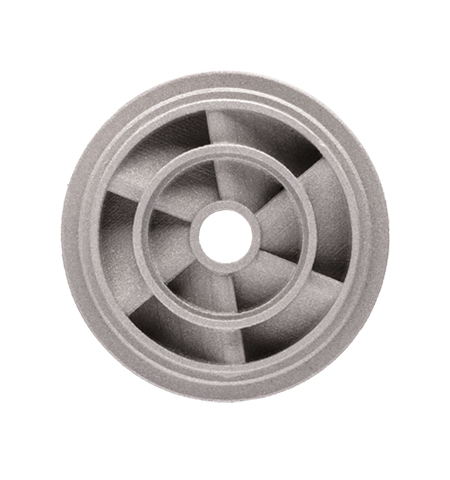
Metal Binder Jetting
A powder-based process followed by sintering—achieves density and strength comparable to MIM while offering a high degree of design freedom for complex geometries. This makes Metal Binder Jetting one of the most cost-effective methods in metal 3D printing.
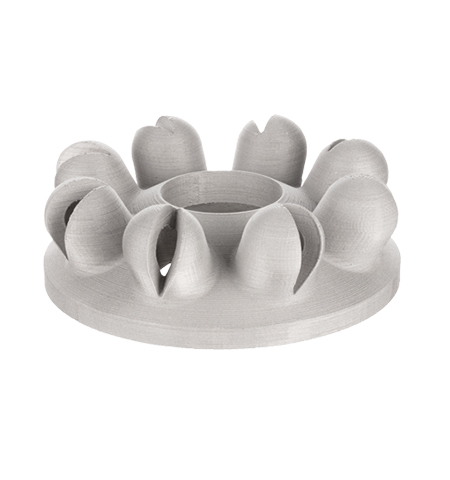
Bound Metal Deposition
A two-step printing process for custom, high-strength parts with complex geometries—ideal for rapid iterations prior to production approval.
Where Metal 3D Printing Is Already Being Used Today
Toolmaking
Tools made of M2 or WC-Co
Thermal
Heat exchangers made of copper or SiC
Medical technology
MIM replacement parts or pre-production parts made of stainless steel
Where Metal 3D Printing Is Already Being Used Today
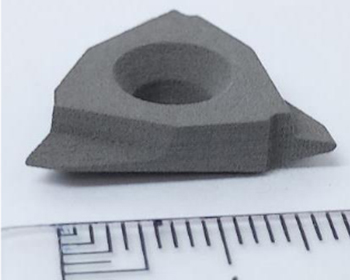
The binder jetting process enables the additive manufacturing of complex tools made of WC-Co and M2 tool steel with high precision to the final contours. This reduces the amount of subsequent machining required. At the same time, the high degree of design freedom enables the integration of internal channels and complex structures that are difficult or costly to achieve using conventional manufacturing methods.
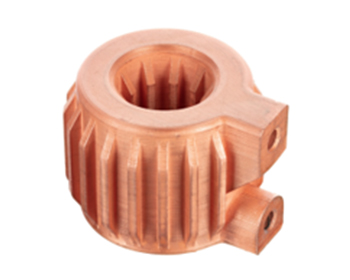
Desktop Metal’s Studio System enables the additive manufacturing of complex copper heat exchangers. A particular advantage is the ability to create internal channels using self-supporting geometries without the need for additional support structures. This makes it possible to implement complex channel configurations and compact heat exchanger designs that are difficult to produce using conventional manufacturing methods.

Medical grippers for minimally invasive procedures can be manufactured using the Binder Jetting process. Complex geometries and functional structures can be integrated directly into the component design. Furthermore, no tools are required for manufacturing, making the production of smaller batches economically viable.
Material Portfolio
High-Performance Materials for Metal 3D Printing
Comparison of Materials
Characteristic values according to Desktop Metal material data sheets (PureSinter Furnace) — Values are given for the specified test conditions.
| Criteria | 316L | 304L | 17-4PH (H900) | IN625 | IN718 | M2 | CoCrMo | Ti64 |
|---|---|---|---|---|---|---|---|---|
| Tensile Strength [MPa] | 540 ± 11 | 560 ± 10 | 1.205 ± 18 | 695 ± 7 | 1.270 ± 11 | – | 1.100* | 935 ± 4 |
| Elongation at break [%] | 77,3 ± 5 | 72,4 ± 3 | 8,9 ± 3 | 71,3 ± 4 | 12,8 ± 1,4 | – | 8* | 12,1 ± 2,4 |
| Modulus of elasticity [GPa] | 188 | 196 | 197 | 204 | 205 | – | 220* | – |
| Hardness | 64 ± 2 HRB | 71 ± 1,2 HRB | 38,7 ± 1,4 HRC | 79,1 ± 2 HRB | 43,1 ± 0,7 HRC | 60,9 ± 0,6 HRC | 35–40 HRC* | 32 ± 0,8 HRC |
| Density [g/cm³] | 7,79 ± 0,09 | 7,73 ± 0,02 | 7,68 ± 0,02 | 8,35 ± 0,02 | 8,229 ± 0,002 | 8,11 ± 0,003 | 8,3* | 4,36 ± 0,003 |
Values according to Desktop Metal material data sheets, PureSinter Furnace (316L/304L/17-4PH/IN625: Shop System™, as-sintered or H900 heat-treated; IN718: Shop System™, HIP + heat-treated; M2: X-Series™, hardened & triple-tempered, bending strength = TRS strength; Ti64: Studio System™, as-sintered). “–” = not listed in the data sheet. * CoCrMo: Approximate value from the literature; no data sheet available. For binding values, see the respective material data sheet.
Frequently Asked Questions About Metal 3D Printing
Which metal is best suited for my application?
The choice depends on the load, the environment, and the number of parts: 316L for corrosive environments, tool steel for wear parts, and nickel-based alloys for high-temperature applications. Our potential analysis for metal 3D printing provides specific recommendations in this regard.
At what production volume does metal 3D printing become cost-effective?
Since there are no tooling costs, metal 3D printing is economically viable even for batch sizes as small as 1 and remains competitive with MIM or machining even for production runs in the four-digit range.
What does the post-processing involve?
Depending on your requirements, we can offer mechanical machining, electropolishing, or electroplating—we’ll work with you to determine the scope of the finishing process.
How soon will I receive a sample?
Depending on the procedure and workload, between 1 and 4 weeks—a specific date will be provided with the quote within 24 hours.
Request system consultation or parts
Upload your drawing—our team will get back to you within 24 hours with a technical assessment.