

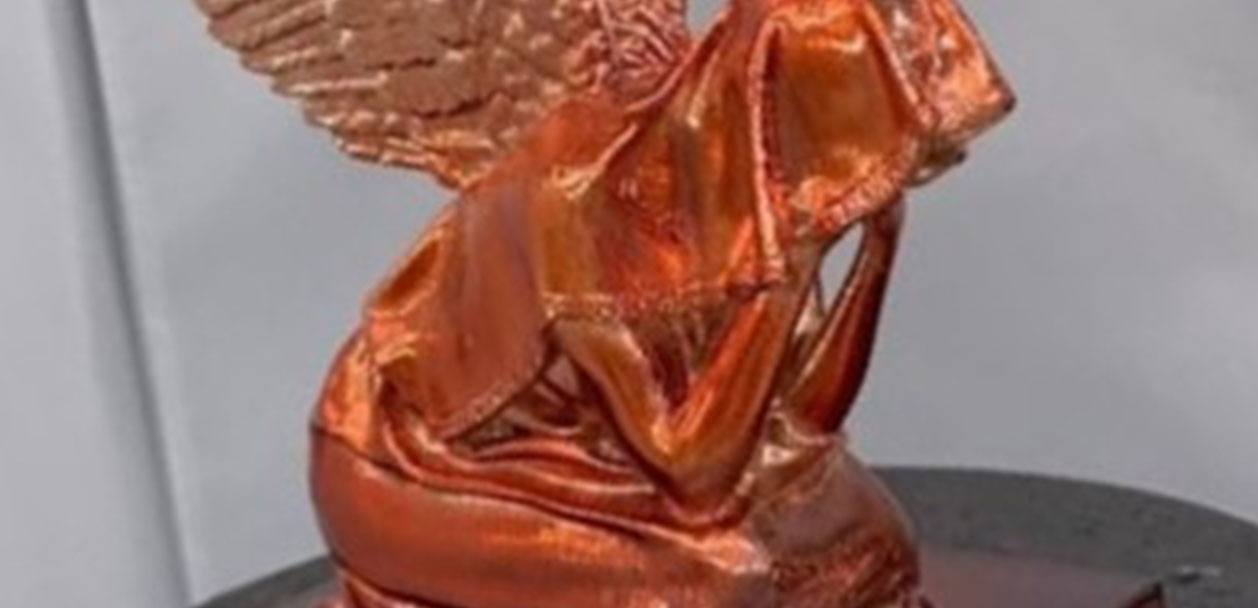
Art from the 3D printer
In September, we received a rather unusual request for a 3D-printed component. While the focus is normally on functional parts and prototypes, artist Christopher Hopp had a completely different idea.
A sculpture was to be produced using a 3D printer. Christopher Hopp, born in 1984, comes from graffiti and street art, the influence of which can be seen primarily in his choice of color palette. He applies strikingly strong, dynamic colors to the canvas with a pronounced sense of aesthetic expressiveness. In his paintings, colors combine and penetrate each other in a fascinating and harmoniously balanced interplay of great luminosity. (https://blackgallery.art/christopher-hopp.html).
Bright Testing GmbH normally focuses on the areas of testing technology, assembly technology and electronics. AM Pioneers GmbH was therefore founded as a subsidiary to cover the field of additive manufacturing. AM Pioneers’ business activities include the sale of industrial 3D printing systems, engineering in the field of additive manufacturing and the production of prototypes and small series. In addition to classic FDM printing and continuous fiber printing, the Desktop Metal systems can now also be used to print stainless steel in industrial quality.
After receiving the order, a suitable CAD model first had to be found, which forms the basis for every 3D-printed component. In order to be able to produce the model on standard 3D printers, it must be prepared in a so-called slicer. This software creates a model that is built up layer by layer by the 3D printer.
Defining the optimum parameters for the printing process requires a great deal of expertise. For example, the layer height, nozzle temperature and printing speed must be defined. The alignment of the model during the printing process is at least as crucial for the quality of the component. In 3D printing, a compromise must always be found between component quality and printing speed. For the production of the sculpture, the focus was therefore more on surface quality than on speed. Once the component had been printed, minor finishing work had to be carried out, such as removing the support structures.
At this point, the component was handed over to the artist Christopher Hopp for further processing. To give the component the finishing touches, it had to be sandblasted and then painted. The finished sculpture was exhibited in the Blackgallery, the artist’s platform. The overall result shows that 3D printing technology is also suitable for the production of visually appealing components.


