

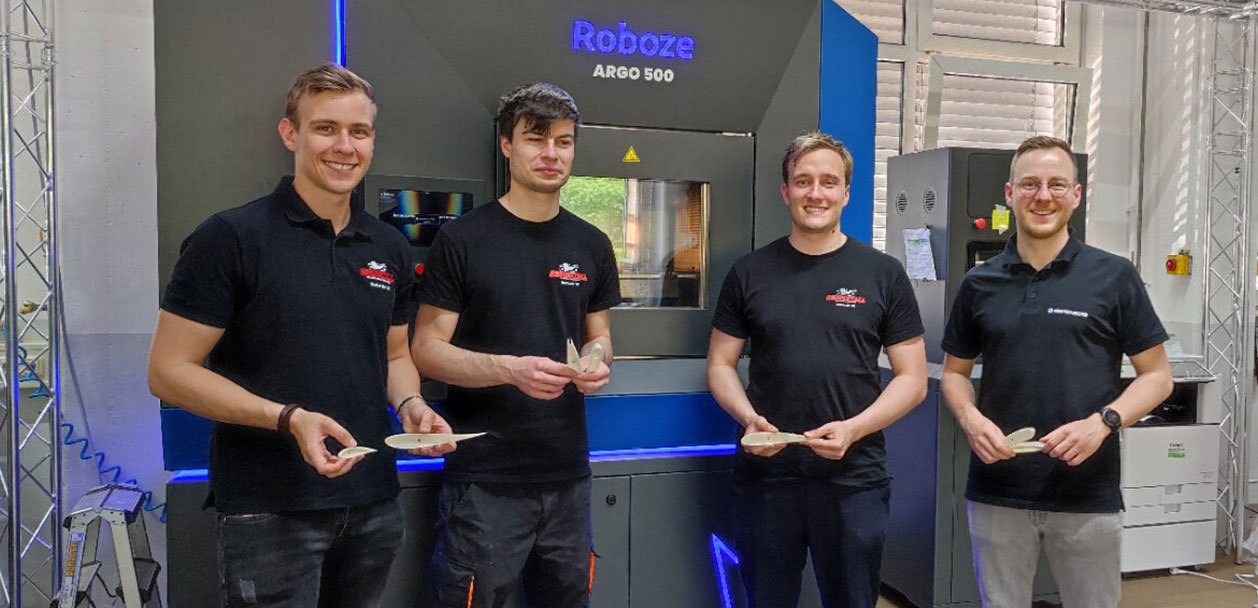
Development of the Stallardo ’22 racing team
AM Pioneers was able to support the Formula Student Team “Rennstall” of Esslingen University of Applied Sciences this year in the development of a new wheel package concept for the front axle of the Stallardo ’22. A complex geometry and demanding requirements for the brake system made this an exciting challenge for us. To connect the brake cooling duct, we 3D printed 4 different connectors, all varying in shape and size, as each individual part is adapted to the front wing interior and the end plate. Read the project report from the university team here.
The completely redesigned wheel pack concept on the front axle for the Stallardo ’22 means that the brake system has been completely redeveloped. The inverted connection of the brake calliper, also known as the perimeter brake system, as well as the inverted arrangement of the wheel pack, make the required installation space for a hybrid concept with wheel hub motors on the front axle possible. Furthermore, the flow of force from the tire contact patch to the wishbones and the damper system is significantly shortened. The new wheel package concept also ensures greater rigidity and therefore more direct power transmission.
To get the maximum performance out of the brake system, it is particularly important that the brake system operates within the correct temperature window. Temperatures that are either too hot or too cold lead to lower friction coefficients between the brake pad and the brake disk and thus to a reduction in braking performance. To prevent the brake system from overheating and to protect surrounding components, such as the CFRP rim and the magnets of the wheel hub motor, air is actively directed behind the front wing via a channel between the pads and the disc. Thanks to the support of AM Pioneers, it is possible for us as a team to implement the connection of the brake cooling duct. The brake duct is also made from CFRP itself, which means that it also has to be protected against high temperatures.
The connection is made up of two parts. The short connecting piece (1) serves as a connection adapter, provides temperature shielding and thus acts as an insulator between the duct and brake calliper. The counterpart (2) is bonded directly to the duct with a high-temperature-resistant two-component adhesive.

Thanks to the two-part concept, it is possible to make changes to the positioning at any time. Both parts are bolted together to the brake calliper. The selection of the high-temperature-resistant plastic Peek makes it possible to implement this connection in the first place, as temperatures of over 200°C can occur on the brake caliper itself. The entire racing team would like to thank AM Pioneers for their support and uncomplicated cooperation.
The 4 different 30 pressure parts are connecting pieces. As can be seen in the illustration, the parts in the area marked in red serve as connecting pieces between the front wing and the end plate. There are 4 connection points per side on the end plates with the front wing, which are ensured by the components as already mentioned. Figure 2 shows a 3D printed part. This is attached to the end of the front wing so that the end with the hole faces the end plate.
The jacket (see illustration below) serves as a flange connection between the inside of the front wing and the printed component. Adhesive is applied to it to fix the component in place. The width of the jacket provides the adhesive with a large attachment surface, which leads to a large retention force and thus keeps the component very stable in position. The circular washer at the hole in the component serves as a support surface for an aluminum turned part. A screw is attached from the end plate through the hole of the 3D printed part into the turned part. This clamps the printed component firmly between the end plate and the turned part and connects it to the front wing.

- Surface area
- Profile page
- Front wing inner side
- End plate
As can be seen in the following illustration, the printed parts all vary in shape and size, as each of the 4 components is adapted to the front wing interior and the end plate. The complex geometry therefore makes it very difficult to produce them with a standard 3D printer. Accuracy also plays a major role, which is why good print quality is required.


