

The potential of 3D printing technical ceramics in the defense sector
Increasing geopolitical tensions are leading to rising defense spending worldwide. At the same time, modern conflicts are significantly accelerating the technological development of military systems. This is particularly evident in the example of drone development in the Russian war of aggression against Ukraine, where innovations are being put into practice in a very short space of time. In order to keep pace with this dynamic, armed forces are looking for new materials and manufacturing technologies that enable high-performance, lightweight and quickly available components.
The 3D printing of high-performance ceramics plays a key role here. Technical ceramics are known for their exceptional material properties and offer significant advantages for demanding applications in the defense sector.
Why technical ceramics?
Technical ceramics combine low weight with outstanding mechanical properties. Compared to metallic materials, they have a high degree of hardness, excellent wear resistance and high dimensional stability under load. They are also temperature-resistant, corrosion-resistant and chemically inert, which means they function reliably even under extreme operating conditions.
Another key advantage is their high permeability to electromagnetic waves. In contrast to metals, technical ceramics hardly impair signal transmission. This makes them ideal for applications in radar, radar domes and modern communication systems.
Areas of application in the defense sector
The combination of low weight and high performance opens up numerous application possibilities:
- Weight reduction in military platforms: By replacing metallic components in armored vehicles, aircraft or missiles, weight and energy consumption can be reduced and range and payload increased.
- Ballistic protection: Technical ceramics are already used in tanks, protective vests and armored vehicles to effectively fend off bullets and shrapnel.
- High temperature applications: Hypersonic drives, rocket components and systems for re-entry into the earth’s atmosphere require materials that can withstand extreme temperatures and strong temperature gradients. Technical ceramics offer optimal conditions for this.
Customized materials with 3DMix
To further improve the performance of additively manufactured ceramic components, 3DCERAM has developed the material platform 3DMix material platform. These formulations, specially designed for Ceramaker printers, enable the processing of certified ceramic powders and can be individually adapted to the requirements of the respective application. This allows material properties and printing processes to be specifically optimized.
Stereolithography as a key technology
Stereolithography (SLA) is one of the most precise processes for ceramic 3D printing. It enables the production of complex geometries with high dimensional accuracy and excellent surface quality.
For military applications, the top-down SLA process in particular offers decisive advantages. While bottom-up systems require each layer to be detached from the build platform, resulting in size and weight limitations, the top-down approach allows the production of larger and heavier components. This reduces the need for assemblies and joints and increases the structural integrity of the components – a key factor for safety-critical applications.
From prototype to series production
One of the biggest challenges of ceramic 3D printing continues to be increasing productivity to such an extent that the transition from research and development to industrial series production can be realized economically.
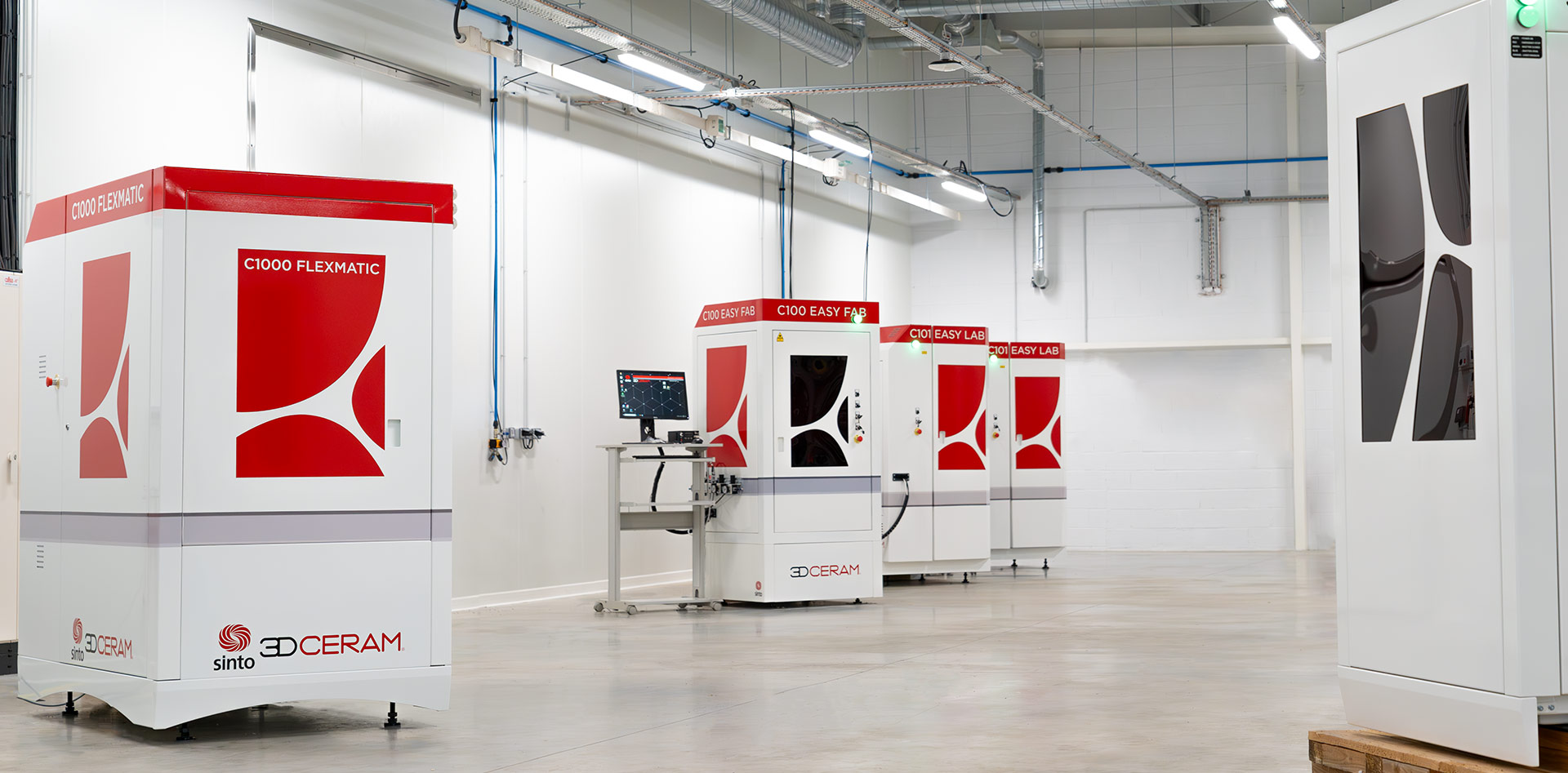
3DCERAM offers a scalable portfolio of printing systems for this purpose – from the C101 EASY for rapid prototyping with an installation space of 100 × 100 × 150 mm up to the industrial production systems C1000 FLEXMATIC and C3601 ULTIMATE for the series production of sophisticated ceramic components.
Conclusion
3D printing of technical ceramics opens up new opportunities for the defense sector to develop high-performance, lightweight and durable systems. The combination of innovative materials, high design freedom and advanced manufacturing technologies enables applications that would be difficult or impossible to realize with conventional manufacturing processes. With the increasing industrialization of additive manufacturing, ceramic 3D printing will play an increasingly important role in the development of modern defence technologies in the future.
Would you like to find out more about the potential of ceramic 3D printing in the defense sector? Then please contact us here.

Wejdane Ezzine
Sales Engineer 3DCeram
+49 172 7 660 451
wejdane.ezzine@am-pioneers.com