

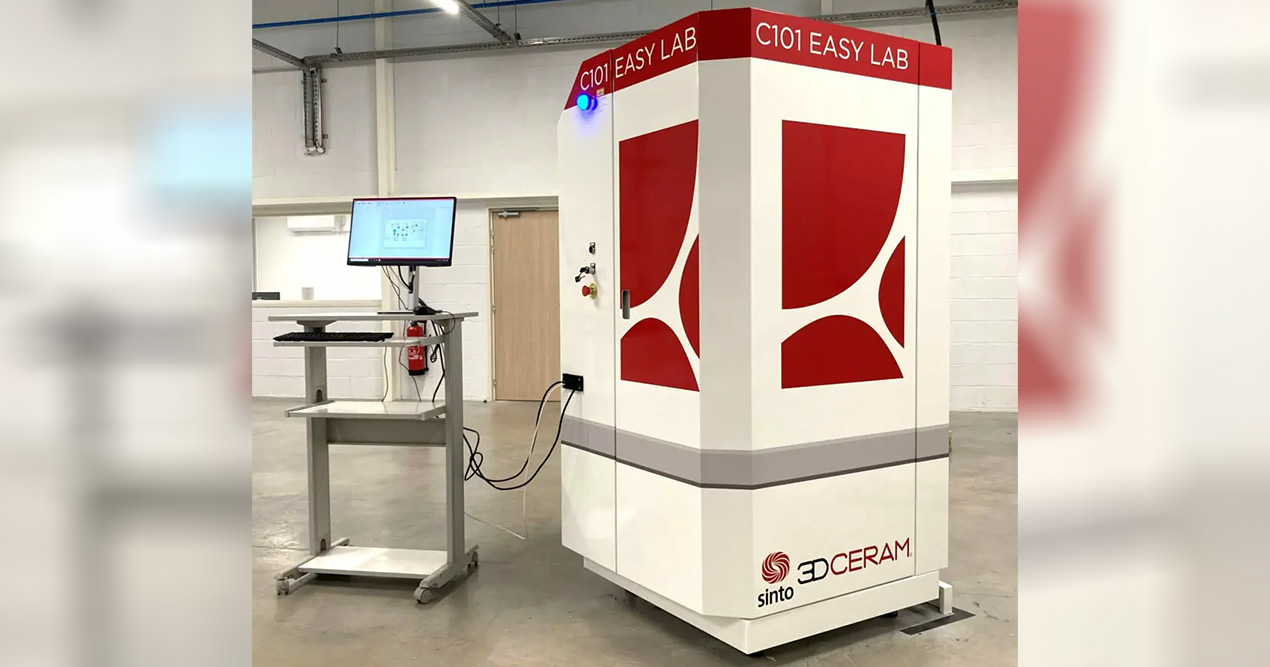
3DCeram C101 Easy Lab
The Open-Source Ceramic 3D Printing System for Research
Ceramics are not a single material—ceramics are a class of materials. Aluminum oxide and silicon nitride, zirconium dioxide and aluminum nitride, hydroxyapatite and cordierite: Each of these materials has its own chemistry, its own sintering conditions, and its own challenges. That’s why researchers working with ceramics don’t need a system that perfectly masters a single material—but one that’s flexible enough to work with any material.
That is precisely the design philosophy behind the 3DCeram C101 Easy Lab.
Ceramic 3D printing in research: a unique challenge
Industrial users seek reproducibility. Researchers, on the other hand, work with the unknown: new formulations, new powder blends, and materials that no one has ever printed before. In this environment, a closed system—with strictly defined materials and locked parameters—is not a tool, but an obstacle.
The C101 Easy Lab is specifically designed as a 3D printer for the research and development of high-performance ceramic materials: all print parameters are openly accessible, individually adjustable, and freely configurable.
The Open System: Design Your Own Parameters
The key feature of the C101 Easy Lab from 3DCeram is its open system concept. It offers the ability to develop and implement custom parameters, as well as to optimize printing precision elements—both mechanical and optical.
What does this mean in practice? Anyone developing their own ceramic suspension can account for its specific absorption behavior in the UV range and adjust the laser exposure accordingly. Anyone processing a material with specific shrinkage characteristics can individually calibrate layer thicknesses and heating rates. Anyone testing new binder formulations is not bound by combinations approved by the manufacturer.
Technology: UV Laser Stereolithography
The C101 Easy Lab’s printing process is based on laser stereolithography (SLA). A UV laser with a wavelength of 405 nm and a power of 300 mW cures the ceramic suspension layer by layer—from the bottom up—with a laser beam diameter of approximately 60 µm.
SLA 3D printing enables the step-by-step construction of a part from the bottom up. After each layer is applied, the print bed moves down one step, ensuring uniform shrinkage during curing and thus higher precision, allowing for the reproduction of the finest details.
The layer thickness can be adjusted between 0.020 mm and 0.125 mm. The print bed measures 100 × 100 × 150 mm: compact enough for the lab, yet large enough for complex test specimens and functional prototypes.
The Range of Materials: Oxide and Non-oxide Ceramics
The C101 Easy Lab is designed for both oxide and non-oxide ceramics—a breadth of materials that is not common in additive manufacturing of ceramics.
Oxide ceramics

Aluminum oxide (Al₂O₃) – The most widely used ceramic material. Retains its mechanical strength even at high temperatures and has good electrical conductivity. Used in insulators, cutting ceramics, and wear-resistant surfaces.
Zirconia (ZrO₂) – Excellent mechanical properties at room temperature and high temperatures. Hard, wear-resistant, chemically inert. Available as ZrO₂ and zirconia 8Y (partially and fully stabilized).
Hydroxyapatite (HA) and tricalcium phosphate (TCP) – Bioresorbable calcium phosphates for biomedical research: bone substitutes, scaffolds, patient-specific implants.
Silicon dioxide (SiO₂) – For optical applications, foundry cores, and components with specific dielectric properties.
Alumina Toughened Zirconia (ATZ) – Toughened alumina with added zirconium: higher fracture toughness, high hardness. Relevant for tribological applications.
Cordierite – Extremely low coefficient of thermal expansion. Ideal for components subjected to high thermal stress with high thermal shock resistance.
Non-oxide ceramics

Non-oxide ceramics are the specialists among engineering ceramics—extremely high-performance mechanically, but challenging to process using additive manufacturing. The fact that the C101 Easy Lab can also be used for this application is a key unique selling point.
Silicon nitride (Si₃N₄) – One of the hardest and most durable ceramic materials. Resists thermal shock, wear-resistant, corrosion-resistant. Used in pumps, valves, semiconductors, and high-temperature structural components.
Aluminum nitride (AlN) – Highest thermal conductivity among non-oxide ceramics, combined with excellent electrical insulation. Strategically important for power electronics, high-frequency technology, and thermal management.
The ability to process oxides and nitrides in a single system sets the C101 Easy Lab apart from many systems that are limited to a single material group. In materials research, where comparing materials and developing novel compositions are part of daily operations, this flexibility is not an option—it is a prerequisite.
SAM Option: Research with Valuable Materials
Specialty ceramics are expensive. Print-quality aluminum nitride, proprietary binder formulations, experimental powder mixtures—researchers working with such materials cannot afford to use large quantities for a test print.
With the SAM (Small Amount of Material) option, 10 ml of ceramic is sufficient to start a print. That’s equivalent to a small test tube. For teams that synthesize their own ceramic suspensions, the SAM option is often the deciding factor when selecting a system. Additional cartridge sizes (60 ml, 180 ml, 360 ml, 600 ml, 920 ml) scale with the development phase.
Technical Specifications at a Glance
| Parameter | Value |
| Printing Technology | UV Laser Stereolithography (SLA) |
| Wavelength | 405 nm |
| Laser power | 300 mW |
| Laser beam diameter | ≈ 60 µm |
| Print volume | 100 × 100 × 150 mm |
| Layer thickness (Z-axis) | 0.020 – 0.125 mm |
| Minimum material volume | 10 ml (SAM option) / 60 ml standard |
| Cartridge sizes | 10 ml, 60 ml, 180 ml, 360 ml, 600 ml, 920 ml |
| System Dimensions | 1095 × 1070 × 1980 mm (L × W × H) |
| Weight | ≈ 600 kg |
| Power Supply | 220–240 VAC / 50 Hz |
| Ambient Temperature | 20–25 °C (± 1 °C/h) |
| Hybrid Option | Available |
Areas of Application in Research
- Materials Science and Engineering – Development of new ceramic suspensions, binder formulations, and sintering parameters. Comparative materials studies.
- Biomedical Research – 3D printing of bone replacement structures, patient-specific scaffolds, and drug-delivery systems made of resorbable ceramics.
- Power Electronics and Semiconductors – AlN substrates for thermal management; precision ceramics for high-frequency applications.
- Aerospace – Prototypes made of high-temperature ceramics such as Si₃N₄ or stabilized ZrO₂.
- Energy and Environmental Technology – Ion-conducting ceramics for fuel cells and sensors; filter membranes.
AM Pioneers: Ceramic 3D printing from a single source
With over 15 years of experience in the field of laser stereolithography for ceramics, 3DCeram has acquired unique expertise. AM Pioneers distributes 3DCeram systems in Germany and Austria and supports research institutions, universities, and industrial laboratories with system selection, commissioning, and process development—including the thermal process chain (debinding and sintering) using the appropriate Carbolite Gero furnaces.
Are you interested in purchasing a ceramic 3D printer? Then please feel free to contact us.