

Binder jetting for technical ceramics and carbon
Materials and fields of application of future-oriented 3D printing technology
In additive manufacturing, binder jetting is often first associated with the processing of metallic materials. However, a technologically particularly exciting field often remains in the background: the processing of technical ceramics and carbon-based materials. This is precisely where the process shows its potential for highly complex applications, industrial scaling and new solutions in future industries.
Potential of technical ceramics in binder jetting
The binder jetting process enables the processing of high-performance ceramic materials such as silicon carbide (SiC) and boron carbide (B₄C). These materials are characterized by exceptional properties:
- Extreme hardness
- High temperature resistance
- Very good thermal conductivity (especially SiC)
This combination makes them particularly interesting for demanding applications in the aerospace and defense industries as well as in chemical process engineering.
Ceramics: 3D-printed space mirrors
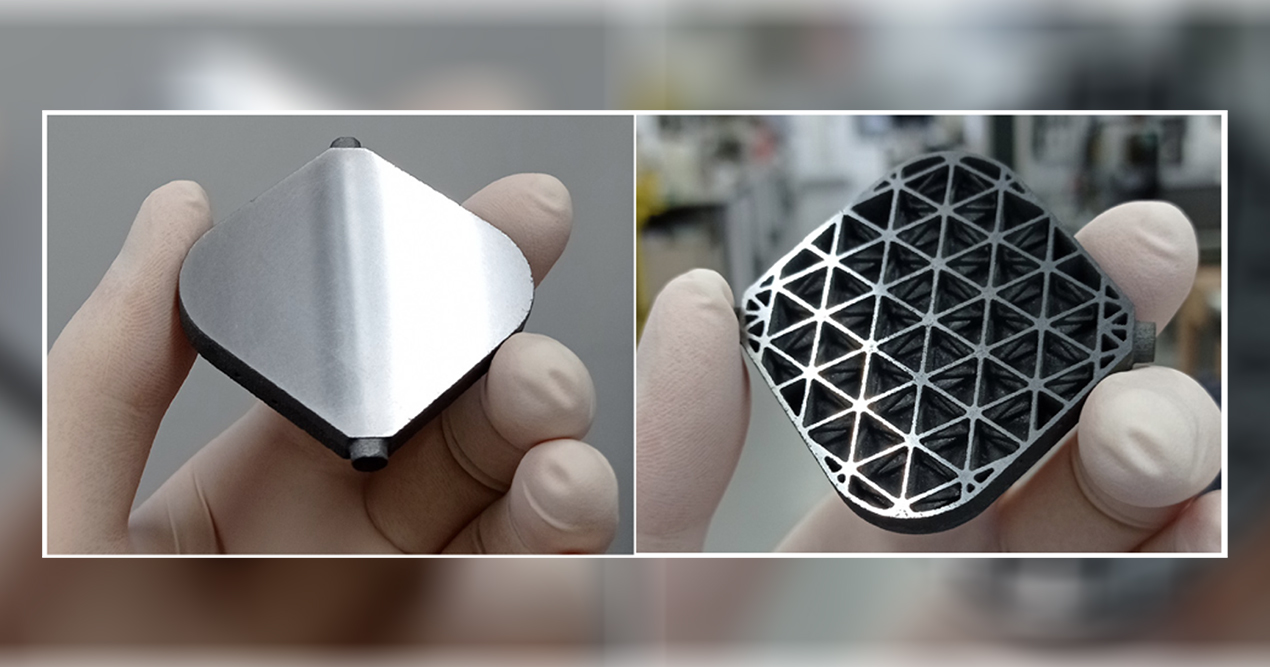
One particularly impressive field of application is 3D-printed mirror structures made of SiC for satellites.
Binder jetting can be used to create complex, weight-optimized geometries that would be almost impossible to produce using conventional manufacturing processes. This has several advantages:
- Reduction in mass with the same optical performance
- Possibility of larger mirrors with the same take-off weight
- Less post-processing work due to near-net-shape production
As part of a project between the Tecnalia research institute and the aerospace company SENER, binder jetting has reduced the weight of SiC mirror structures by around 15%. At the same time, the effort required to polish the final surfaces was reduced by around 35%. (Source: Desktop Metal)

Ceramics: Individualized protection solutions for the defence industry
Binder Jetting also offers new possibilities in the area of personal protection systems.
Ceramics such as SiC and B₄C are ideal for ballistic protection applications due to their high hardness. Thanks to 3D printing, protective plates can be individually adapted to body shapes – a significant advantage over standardized solutions.
The process also allows the production of large-format structures, for example on systems such as the X160Pro with a construction volume of 500 × 800 × 400 mm.
The combination of material performance and design freedom opens up new possibilities for:
- Vehicle armor
- Helicopter protection systems
- Individual personal protective equipment

Carbon: 3D-printed reactors for hydrogen production
One particularly innovative field of research is the use of binder jetting for printed support structures for graphite reactors.
Printed gyroid structures made of graphite can be used as reactors to break down methane (CH₄) into hydrogen (H₂) and solid carbon – without direct CO₂ emissions in the process.
The process is considered a promising approach for more climate-friendly hydrogen production, as it is more efficient than conventional processes:
- less CO₂ emitted
- enables high-purity hydrogen
- stable carbon, which can be reused for graphite applications, for example
The SUPSI research institute has successfully produced and tested graphite structures on the InnoventX system. According to the researchers, SUPSI is one of the first institutes in the world to publish on additively manufactured graphite structures.
Large-volume binder jetting platforms, such as the X25 Pro System and the X160 Pro System from ARC-Impact (formerly Desktop Metal), are used for the industrial scaling of such reactors.

Conclusion: A technology with a future
Binder jetting is increasingly developing into a key technology for high-performance materials beyond traditional metal applications. The enormous innovation potential is particularly evident in the field of technical ceramics and carbon.
Whether in aerospace, defense or energy technology – the combination of design freedom, material performance and scalability makes the process an important building block for future industrial developments.
The examples clearly show that 3D printing of ceramics and carbon is no longer a niche topic, but a strategically relevant field of technology for important future industries.
What is Binder Jetting? If you would like to find out more about the process, take a look at our YouTube channel: