

InnoventX: Microstructure Research Using the Binder Jetting Process
Not every application of binder jetting is aimed at mass production. For universities, research laboratories, and materials developers, a different question usually takes center stage: How can the printing process itself be systematically understood and specifically further developed? That is precisely why Desktop Metal has created InnoventX, an open binder jetting system specifically designed for research and education.
A Binder Jetting System Designed for Openness
Unlike production-oriented systems such as the Shop System or the X-Series, Desktop Metal InnoventX is consistently designed for flexibility rather than throughput. The platform offers open access to process parameters and processes a wide range of materials, from traditional metal powders to unusual alloys such as copper and engineering ceramics such as silicon carbide. A compact form factor and a small build volume (<1 L) ensure that research institutions can test processes without having to stock large quantities of expensive powders. Changing materials is simplified, which saves a significant amount of time, especially when comparing multiple materials in the lab.
Case Study: Microstructure Research at San Diego State University
The Powder Technology Laboratory (PTL) at San Diego State University demonstrates how this openness is utilized in practice. Under the direction of Dr. Eugene Olevsky and Dr. Elisa Torresani, the lab investigates how anisotropic microstructures form and change during the sintering process in binder jetting—specifically, pore distribution, particle orientation, and packing density at various stages of the process, as analyzed by computed tomography.
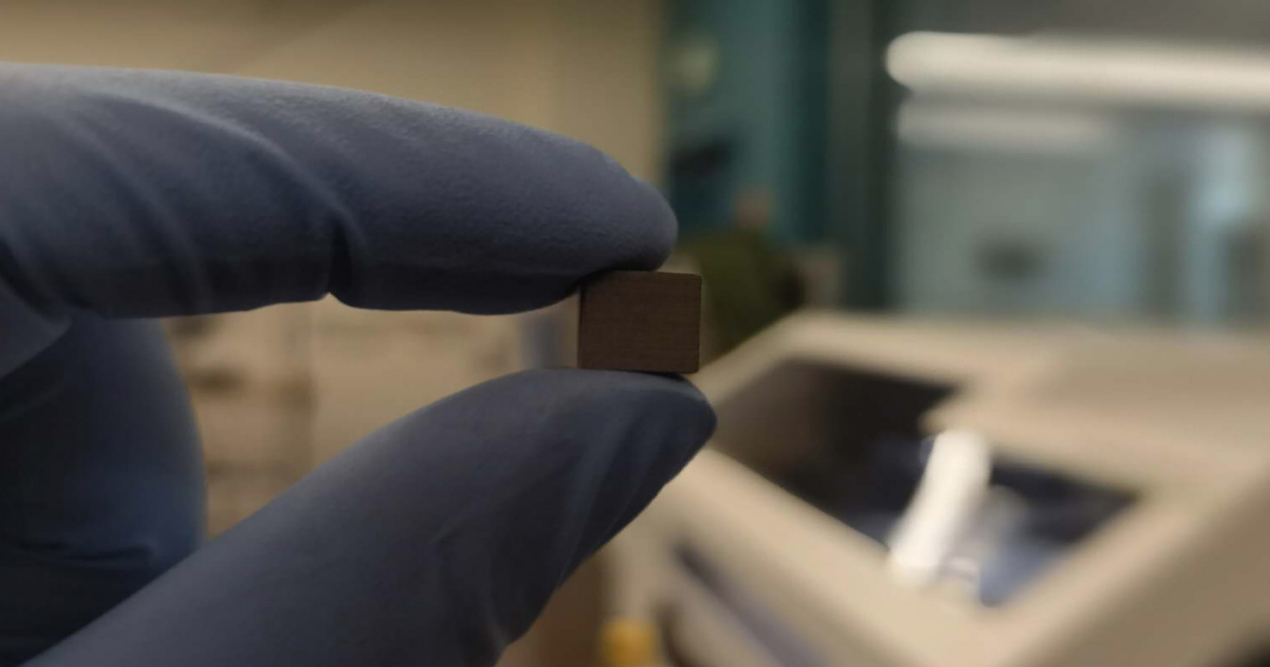
For this type of basic research, InnoventX’s ability to reliably print even very small specimens was crucial. Runjian Jiang, a doctoral student conducting research in the joint doctoral program between UC San Diego and SDSU, sums up the key advantage:
“With InnoventX, I can print a specimen smaller than one millimeter, and that’s very important for my work.” – Runjian Jiang, PhD student, San Diego State University
Such sub-millimeter-sized specimens are essential for subsequent X-ray CT analysis, as this is the only way to visualize the internal structure with sufficient resolution. Jiang also praises the system’s ease of use in day-to-day research:
“It’s easy to correlate the process parameters with the final results. Once a build process starts, everything runs automatically—that’s what I love about the system.”
Currently, the PTL team is working with established stainless steel powders in simple geometries to understand the fundamental process relationships. Plans for the future include expanding to functional and structural materials, composite materials, and engineering ceramics—a sign of just how broad the range of applications for Binder Jetting is already envisioned beyond traditional metal components. The SDSU system was installed in 2024 and is equipped with an ultrasonic recoater that enables particularly uniform powder distribution.
From the Lab to Mass Production: Knowledge Transfer
What at first glance appears to be purely basic research has direct implications for the industrial application of binder jetting. The relationships between powder packing, sintering shrinkage, and the resulting microstructure—which are investigated at the PTL—ultimately determine how precisely mass-produced components can be manufactured on production-oriented binder jetting systems such as the Shop System or the X-Series. The better we understand how pore distribution and particle orientation develop during sintering, the more reliably we can predict dimensional tolerances and mechanical properties in mass production—an aspect that is particularly crucial for safety-critical components in the aerospace and medical technology sectors.
InnoventX also opens up new possibilities at the material level: Because the system is not limited to a narrow, approved material portfolio, research teams can specifically investigate how unconventional materials such as copper alloys or silicon carbide behave in the binder jetting process—materials that are often only available in production-ready systems after years of qualification. This preliminary research thus indirectly shortens the time it takes for new materials to become industrially viable.
Why Open Research Platforms Drive the Entire Industry Forward
Findings from projects like the one at SDSU ultimately feed back into more robust process parameters, better material data sheets, and more reliable mass-production processes—including for production-oriented binder jetting systems such as the Shop System or the X-Series. Research institutions such as Red Deer Polytechnic in Canada also make targeted use of InnoventX for training the next generation of engineers and collaborating with local companies. This demonstrates that the platform has a place not only in pure basic research but also in hands-on education.
Who Can Benefit from a Research Platform Like InnoventX
Not every organization needs a production-oriented system. For materials scientists seeking to fundamentally characterize new alloys or ceramics, for universities looking to integrate additive manufacturing into their curricula in a practical way, and for companies with their own R&D departments that want to explore process windows for new materials, an open Binder Jetting system is often a better choice than a production-ready system that is limited in terms of materials and parameters. The compact form factor also allows for use in labs with limited space, while the small build volume keeps material costs low for exploratory test runs.
Conclusion
With Desktop Metal InnoventX, research institutions have access to an open binder jetting system specifically designed for experiments, material development, and education—compact, compatible with any material, and offering full access to process parameters. Cases such as that of San Diego State University demonstrate how valuable this open access is for basic research in binder jetting.
Are you planning to use binder jetting in research or teaching? AM Pioneers can advise you on InnoventX and help you select the right system for your research goals.

Frederik Nussbaumer
Head of Sales
+49 172 4059105
frederik.nussbaumer@am-pioneers.com