

Micro-3D Printing for Microfluidic Applications
How Heidelberg University Conducts Research Using BMF Technology
Using the micro-3D printing systems from Boston Micro Fabrication (BMF), microfluidic applications made of composite polymers or ceramics can be manufactured with a resolution of up to 2 µm—enabling the creation of channels and tolerances that cannot be achieved with any other 3D printing technology.
In Germany, the University of Heidelberg is among the institutions relying on this technology. This article explores how the IMSEAM Institute is using it for research, what components are being created, and why BMF was the only provider able to meet the requirements.
The Technology: DLP Microprinting with a Resolution of Up to 2 µm
The BMF system is based on projection microstereolithography (PµSL)—a printing process that combines a DLP engine, precision optics, and high-precision motion control. An entire layer is exposed to a UV flash—which triggers rapid photopolymerization of the entire resin area. Continuous exposure is used to speed up processing.
Components are produced with a level of detail previously reserved for photolithography—without a cleanroom, without a master model, and without a multi-step process.
Three resolution levels
- 2 µm series (microArch S230): Highest resolution, layer thickness 5–20 µm. For the finest channel structures and nanofluidic transitions.
- 10 µm Series (microArch S140/S240): Build volume 94 × 52 × 45 mm. Most commonly used configuration for microfluidics research.
- 25 µm Series (microArch S150/S350): Largest build volume for multiple chips per print job.

High-quality materials and an open system
- BIO Resin / BMF MED: Biocompatible for medical and biological applications
- CLEAR Resin: Transparent for optical detection chambers and flow visualization
- HTL Resin / HT 200: High-temperature stable, chemically resistant
- AL Ceramic: Ceramic material for mechanically demanding applications
Open material system: BMF allows third-party materials and extensive adjustments to printing parameters. Research institutions can qualify materials they have developed themselves on the system.
Case Study: The IMSEAM Institute at Heidelberg University
Germany’s oldest university conducts research using state-of-the-art printing technology
Founded in 2022, the Institute for Molecular Systems Engineering and Advanced Materials (IMSEAM) at Heidelberg University (founded in 1386, Germany’s oldest university) develops new materials and technologies at the molecular level—from the molecule to the function. Four research groups and two early-career research groups are working on materials development, organic electronics, environmental engineering, and medicine.
IMSEAM operates three core facilities: the IMSEAM Core Facility for device fabrication and characterization, the facility for characterizing soft (bio)materials, and the Microfluidics Core Facility (µFlu CF), headed by Dr. Sadaf Pashapour.
The Core Facility supports research groups across the entire university—from project design and chip fabrication to conducting experiments in biosafety laboratories.
Why Conventional Photolithography Wasn’t Enough
The facility started with a maskless aligner for 2D geometries (1–200 µm Z-height) and an interference profilometer for measuring the height of structures in the range of 1 µm to 2–3 mm. However, the process has a fundamental limitation: it can produce only straight walls.
True 3D geometries—channels on multiple planes, chambers with variable cross-sections, cavities within components—cannot be realized with this method. This was the catalyst for the search for a 3D printer:
“In addition to this method, which can only produce straight walls, we also wanted to manufacture 3D geometries.”
Why BMF Was the Only Supplier That Met Our Requirements
A typical test part was sent to four or five suppliers. The requirement was clear:
“Our challenge is to print narrow channels with walls as smooth as possible to prevent turbulence later on.”
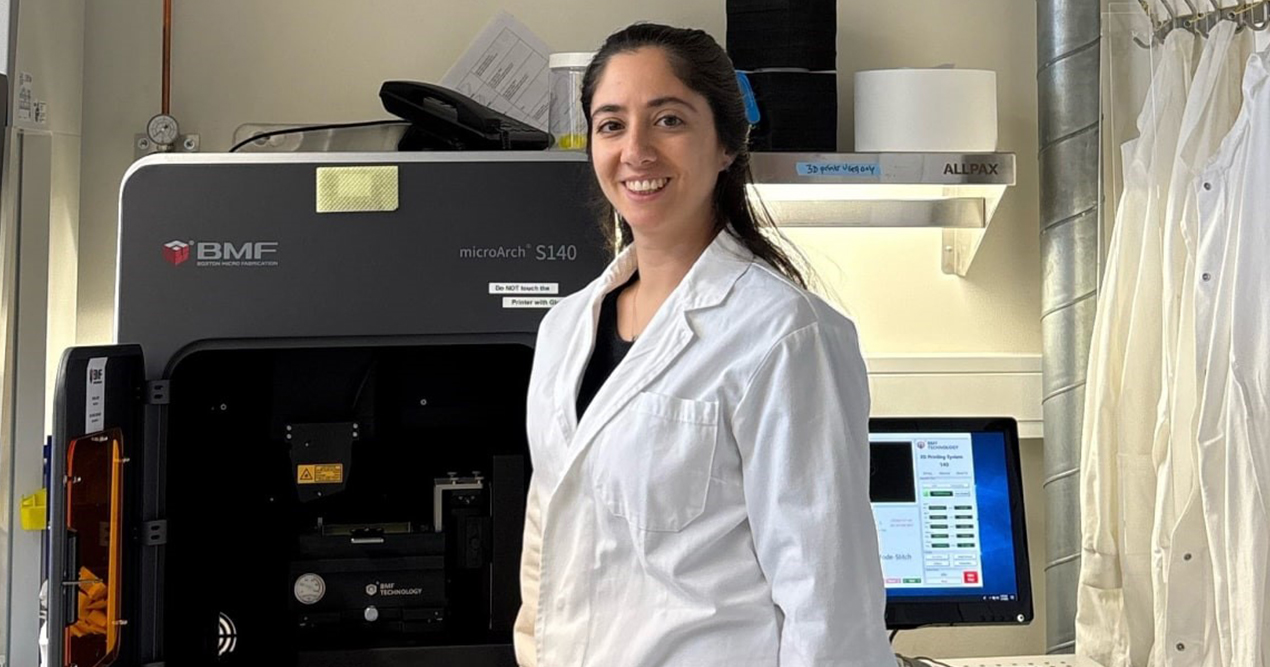
Only BMF was able to produce the prototype part flawlessly. The decision was made to go with the microArch S140 (10 µm)—chosen over the top-of-the-line 2-µm model for budgetary reasons, but with impressive results:
“This incredible machine delivers excellent results.”
After installation: a one-week training session with a complete explanation of the system theory, followed by rapid support via a messaging channel.
Round-the-clock operation and international collaborations
The microArch S140 has been running around the clock since September 2023. Dr. Pashapour operates the system alone to be able to assign priorities as needed:
“While the printer is running, I can prepare new projects, finish processing components, or attend to my other tasks.”
About 20 researchers have already completed projects all the way to the finished chip. Collaborations are in place with the Technical University of Munich, the Leibniz Institute in Saarbrücken, and partners in Chile—the facility has established itself far beyond the campus as a hub for microfluidics research.
The Components: What the System Does in Practice
- Microwells: 80 µm in diameter and depth, spaced 20 µm apart—for trapping GUVs (Giant Unilamellar Vesicles)
- Organoid chambers: 200 µm-wide chambers with 100 µm fluid inlets on both sides
- Lattice structures: 100 µm-fine lattices for cell-induced deformation studies
- Hollow cubes: 150 µm cavities for coating with carbon nanotubes to enable 3D cellular activation
Particularly valuable: Printing directly onto a glass substrate—for better optical analysis. The team would like software support for the micrometer-precise alignment of the glass plate; currently, a caliper is used.
The bottom line: The S140 meets the requirements for accuracy and precision every time.

Outlook: Elastic Materials and the Path to 2-µm Resolution
Dr. Pashapour would also like to use elastic materials in the future—for example, for a synthetic lung as an “organ-on-a-chip.” An initial design was too complex for the microArch S140:
“We sent that to BMF support. Perhaps the 100-micrometer struts can be produced with the 2-µm printer.”
This highlights a key strategic advantage of the BMF portfolio: Designs that push the limits of the 10-µm system can be seamlessly scaled up to the 2-µm top-of-the-line model—within the same system family, using the same materials and the same software.
Applications of the BMF system in microfluidics
Lab-on-a-chip for point-of-care: Integrated mixing chambers, capillary valves, and detection chambers in a single monolithic component—no bonding, no cleanroom.
Organ-on-a-chip: Perfused tissue models, blood-brain barrier simulations, gut-on-a-chip with physiologically relevant shear stress—and, in the future, elastic lung models.
Droplet microfluidics: T-junctions and flow-focusing units for the synthesis of synthetic cells, nanoparticles, and emulsions.
Cell sorting: Dean-flow spirals, hydrodynamic traps, and microwells for controlled cell seeding and single-cell analysis.
Microreactors: Optimized heat transfer, controlled residence times, and integrated mixing zones for chemical synthesis.
Sensor integration: Pressure chambers, optical detection windows, and electrochemical cells as integral structural components of the chip.
The next step: Experience micro-3D printing at AM Pioneers
Would you like to buy a micro-3D printer?
Feel free to contact us. AM Pioneers is an authorized partner of Boston Micro Fabrication in Germany and offers two options:
3D Printing Services: From the CAD model to the finished chip—including feasibility analysis and material consulting, without the need to invest in your own equipment.
System Purchase with Implementation: System selection, installation, and configuration—just as the IMSEAM team from Heidelberg experienced it.
Related Links:
Video on the printing process (YouTube)
User article: University of Heidelberg – IMSEAM (German)
User article: University of Heidelberg – IMSEAM (English)
For an initial consultation about your requirements: am-pioneers.com/bmf