

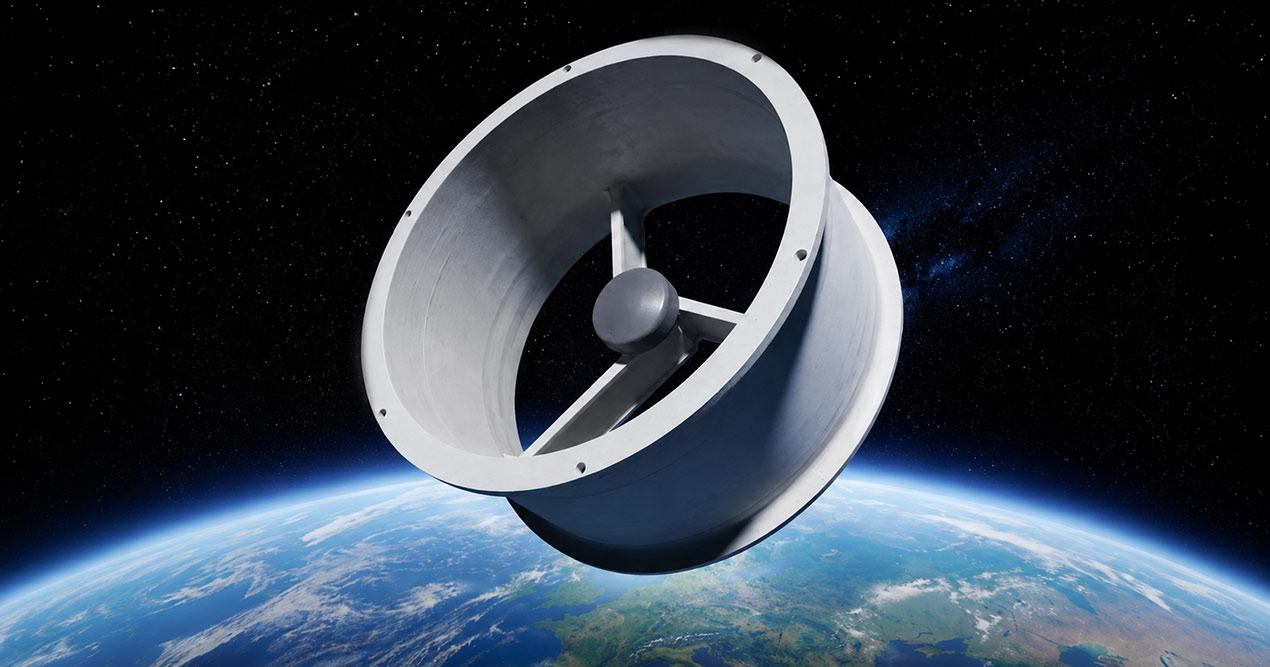
Silicon Nitride from Additive Manufacturing: A Next-Generation Material for Earth-Observation Instruments
The aerospace industry is constantly seeking ways to enhance the performance of satellites, measuring instruments, and optical systems by leveraging the specific properties of ceramics—while maintaining high standards for the performance-to-cost ratio. Earth observation instruments operate precisely within this balancing act: spectrometers, telescope structures, and mirror mounts require materials with high stiffness, a low coefficient of thermal expansion, and low mass, combined with a manufacturing method that allows for complex, functionally integrated geometries.
3DCeram’s reference customers include well-known companies in the aerospace and optics industries, such as Safran, Thales, and Zeiss—an indication that SLA-printed technical ceramics are already being used in industrial applications within these sectors. For silicon nitride in particular, this means that the combination of the material’s properties and the geometric freedom offered by the SLA process opens up potential for topology-optimized mounts, mirror supports, or aperture structures that can be manufactured as an integrated assembly rather than as a multitude of joined individual parts.
Why Silicon Nitride?
Silicon nitride is not a new material in the aerospace industry. Companies such as Thales Alenia Space have been using it for more than ten years for structural components in optical instruments, such as tubes, mounts, and support structures.
The material is particularly well-suited because it combines two important properties: it is very strong and rigid, yet expands only very slightly in response to temperature fluctuations. This is crucial for telescopes and spectrometers. Their structures must withstand the high stresses of rocket launch while simultaneously maintaining their precise alignment in orbit despite fluctuating temperatures.
These advantages have already been demonstrated in many space applications. Silicon nitride components have been extensively tested and qualified, and are now successfully in use in orbit.
Traditionally, silicon nitride components are manufactured through sintering, injection molding, or slip casting—processes that quickly reach their limits when dealing with complex geometries. Additive manufacturing opens up new possibilities here because it allows for the creation of structures that would be practically impossible to produce using conventional methods. Combined with topology optimization, this drastically reduces the weight of components without compromising their mechanical integrity.


Why SLA for Technical Ceramics?
Among additive manufacturing processes for ceramics, stereolithography (SLA) holds a special place. In contrast to the powder-bed process, a light-sensitive, ceramic-filled slurry is cured layer by layer using a laser. This allows for the production of components with complex geometries, high dimensional accuracy, and custom designs. These properties are particularly important for applications in aerospace, optics, and medical technology. Compared to traditional methods such as pressing, injection molding, casting, or extrusion, SLA offers significantly greater design freedom, as these methods reach their limits when dealing with complex geometries.
Another process: Fused Filament Fabrication (FFF)
The components are printed from a filament using an extrusion process. The M.A.T desktop 3D printer from 3D Ceram enables the production of such structures via extrusion. After the green body is printed, the polymer matrix is thermally decomposed (debinding), and the remaining ceramic powder is then sintered. Since debinding and sintering proceed relatively slowly in this process, internal stresses are less of a problem than, for example, in laser-based processes. One disadvantage, however, is that incomplete adhesion between individual print layers can significantly impair the mechanical properties, particularly strength.
Challenges on the Path to Flight Readiness (TRL 9)
Additively manufactured silicon nitride offers great potential. However, there are still several challenges to overcome before it can be routinely used in Earth-observation instruments. A reliable and fully traceable process chain is required, ranging from design through manufacturing and post-processing to assembly, testing, and final acceptance.
Silicon nitride presents an additional challenge: 3D printing initially produces only what is known as a “green body.” It is only through the subsequent sintering process that the component acquires its final properties. During this process, size and shape can change, which is why shrinkage, warpage, and material density must be precisely controlled. This is significantly more challenging for complex, additively manufactured components than for conventionally manufactured geometries.
In addition, the material properties must be comprehensively tested. These include, among other things, strength under repeated loading, behavior during vibration tests, and long-term stability in a vacuum. Only after these properties have been verified and qualified for the respective manufacturing process can a component be considered flight-tested.
Outlook
The combination of additive manufacturing and silicon nitride reflects an important trend in aerospace: Instead of manufacturing and assembling many individual components, lightweight, functionally integrated, and optimized structures are increasingly being produced from high-performance materials.
This approach offers great potential, particularly for Earth-observation instruments. Every gram saved reduces the payload weight, and greater thermal stability improves the instruments’ performance. If additive-manufactured silicon nitride can be qualified to the same quality and reliability standards as conventionally manufactured material, future instruments—from trace gas spectrometers to cameras—could benefit from lighter, stiffer, and more complex structures. At the same time, high optical precision could be maintained.
Would you like to learn more about silicon nitride produced via additive manufacturing? Then feel free to contact us here.

Wejdane Ezzine
Sales Engineer 3DCeram
+49 172 7 660 451
wejdane.ezzine@am-pioneers.com