

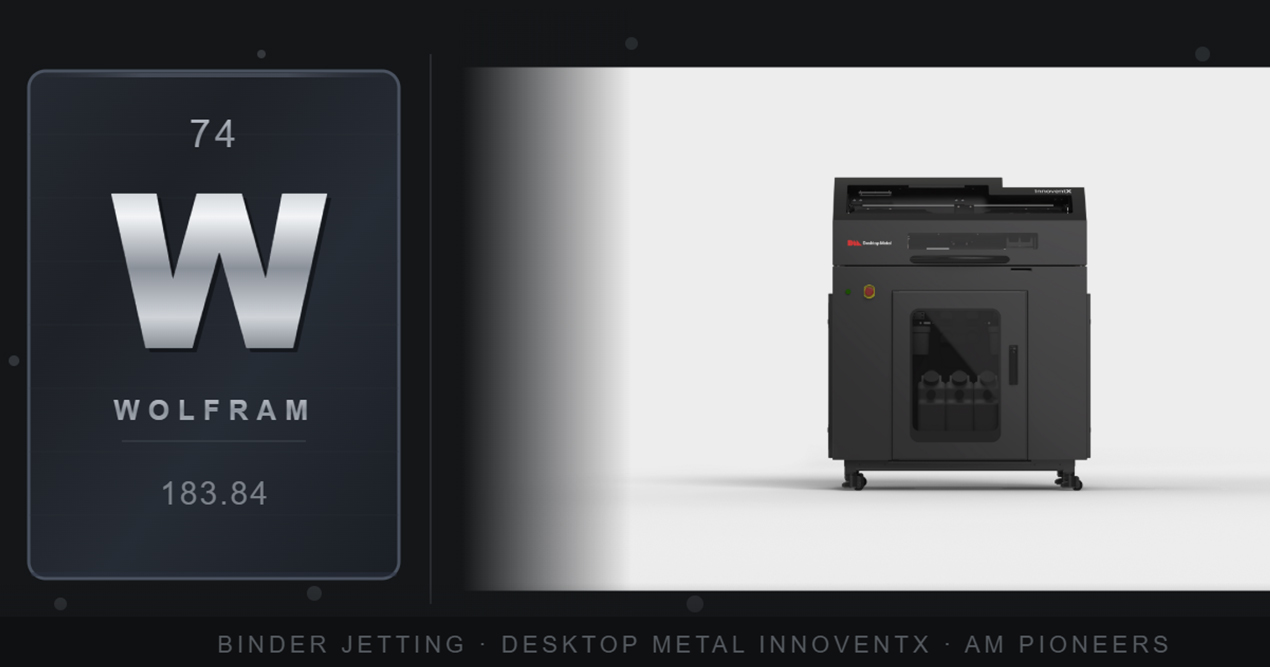
The Potential of Binder Jetting Technology for Tungsten
Tungsten (W) is no ordinary metal. With a melting point of 3,422 °C—the highest of any pure metal—and a density of 19.25 g/cm³ (1.7 times denser than lead), tungsten is one of the most challenging materials in industrial manufacturing. Binder Jetting opens up entirely new possibilities for this exceptional material.
Tungsten: Properties That Push the Limits
| Property | Tungsten (W) | 316L stainless steel | Titanium Ti64 |
| Melting point | 3,422 °C | approx. 1,400 °C | approx. 1,660 °C |
| Density | 19.25 g/cm³ | 7.99 g/cm³ | 4.43 g/cm³ |
| Hardness | 300–500 HV | 140–200 HV | 300–380 HV |
| Modulus of elasticity | 411 GPa | 193 GPa | 114 GPa |
| Coefficient of thermal expansion | 4.5 × 10⁻⁶/°C | 16 × 10⁻⁶/°C | 8.6 × 10⁻⁶/°C |
Tungsten’s extremely low coefficient of thermal expansion, high density, and outstanding melting point make it the material of choice wherever other metals fail. At the same time, tungsten is brittle at room temperature and exceptionally difficult to machine.
Why Conventional Methods Fail with Tungsten
Conventional CNC methods quickly reach their limits due to extreme tool wear. Complex internal geometries—cooling channels, lattice structures, patient-specific collimator contours—cannot be achieved with these methods.
Laser-based additive processes (L-PBF) face a fundamental problem with tungsten: massive residual stresses caused by the temperature gradient during melting lead to cracking and delamination in the brittle tungsten. Special preheating up to 850 °C reduces this problem but makes the process considerably more complex.
Binder jetting fundamentally solves this problem: Since no heat is introduced during the printing process, no thermal residual stresses are generated. The powder is cold-bonded and only compacted during the subsequent sintering step.
Binder Jetting for Tungsten: The Process in Detail
Printing
Tungsten powder (typically D50 10–30 µm) is deposited layer by layer and bonded using the PhenolFuse™ binder system—the only system that produces the highest green strength and was specifically developed for refractory metals.
Triple ACT® technology (Desktop Metal InnoventX) meters, distributes, and compacts the powder using ultrasonic assistance—particularly relevant for tungsten, as the high powder density places special demands on the powder deposition process.

Depowdering and Debinding
After the sintering process, green bodies are depowdered and the organic binder components are thermally removed. The component retains its geometry as a so-called brown body.
Sintering
This is the most challenging step. Different parameters apply depending on the material:
- Pure tungsten: 1,800–2,000 °C in an H₂ atmosphere. Achievable densities: 90–98% of the theoretical density.
- Heavy tungsten alloys (W-Ni-Fe): Liquid-phase sintering at approx. 1,480–1,520 °C. Achievable densities: >99%.
- W-Cu composites: Infiltration after sintering or direct sintering at approx. 1,100–1,300 °C in an H₂ atmosphere.
For these temperatures—especially for pure tungsten—a high-temperature furnace such as the Carbolite Gero HTK 8 (up to 2,200 °C, H₂ operation, metallic W/Mo insulation) is absolutely essential.
Relevant tungsten alloys for binder jetting
Pure tungsten (W ≥ 99.7%): Highest density and temperature resistance. Used for radiation shielding, furnace components, and X-ray targets. Binder jetting enables complex geometries that cannot be achieved through pressing.
Heavy tungsten alloys (WHAs) – W-Ni-Fe, W-Ni-Cu: 90–97% tungsten content, improved toughness, liquid-phase sintering at lower temperatures. Most commonly used in binder jetting. W-Ni-Cu is non-magnetic for MRI-compatible applications.
W-Cu composites: Excellent thermal conductivity (220–240 W/m·K) with a matched CTE. Ideal for thermal management in power electronics.
TZM (titanium-zirconium-molybdenum): Molybdenum alloy as a tungsten alternative for high-temperature applications. Sintering temperatures of 1,800–2,000 °C in H₂. Qualified by Desktop Metal InnoventX.
Application Areas: Where Binder Jetting Excels for Tungsten
Medical Technology: Collimators and Radiation Shielding
Collimators in medical linear accelerators, CT scanners, and X-ray systems shape and focus beam fields. Their geometry—complex internal channels and apertures—is virtually impossible to achieve using conventional methods. Binder Jetting enables patient-specific collimator geometries with internal channel structures that could not be manufactured conventionally.
Radiation shielding made of W-Ni-Fe replaces lead shielding with significantly lower volume while providing the same shielding effect. Lead-free W-Ni-Fe shielding blocks achieve equivalent attenuation at diagnostic energies with a 22% thinner wall thickness—while being fully recyclable.
Aerospace: Heat shields and engine components Tungsten is used in the aerospace industry for engine components, heat shields, heavy-metal balance weights, and components in rocket propulsion systems. Binder Jetting enables topology-optimized heat shields with internal cooling structures—previously unattainable with conventional methods.
Defense: Kinetic Penetrators and Protective Applications
Heavy tungsten alloys are the standard material for kinetic energy penetrators as a lead-free alternative. The design flexibility of binder jetting allows for optimized penetrator geometries and density gradients that cannot be achieved with conventional methods.
Power Electronics: Tungsten-Copper Heat Sinks
Binder-jetted tungsten-copper composites used as heat sinks for GaN power modules achieve a thermal conductivity of 220–240 W/m·K—with CTE matching to ceramic substrates and a 28% weight reduction compared to conventional solutions.
Nuclear Fusion and Nuclear Technology
In the field of nuclear fusion, tungsten is the standard material for plasma-facing components (divertors, first-wall elements). The geometric complexity and extremely low production volumes make binder jetting the ideal manufacturing process.
Challenges and State of Development
Sintering temperature: Pure tungsten requires >1,800 °C—beyond the range of conventional laboratory furnaces. Only high-temperature furnaces, such as those from Carbolite Gero, with metallic insulation are suitable.
Atmospheric purity: Tungsten oxidizes at moderate temperatures. The sintering protective gas atmosphere must be extremely pure.
Shrinkage: 15–22% depending on the alloy and green part density. Sintering simulation tools such as Live Sinter™ are essential.
Powder handling: The high bulk density places special demands on powder application. Triple ACT® with ultrasonic assistance addresses this issue.
Binder selection: PhenolFuse™ has proven to be a robust system for refractory metals—high green strength, residue-free combustion.
Despite these challenges, research has made significant progress: densities of over 95% for pure tungsten parts, and regularly >99% for heavy tungsten alloys.
Binder Jetting vs. Other Processes for Tungsten
| Process | Design Freedom | Risk of Cracking | Cost-Effectiveness (Small Batches) |
| Pressing + Sintering | Low | None | Good |
| CNC Machining | Limited | None | Poor (tool wear) |
| Laser PBF (L-PBF) | Very high | High | Moderate |
| Binder Jetting | Very high | None | Very good |
| MIM | High | None | Poor (tooling costs) |
Binder jetting combines the design freedom of additive manufacturing with the quality advantages of sintering—without the risk of cracking associated with laser-based processes and without the tooling costs of die casting or MIM.
Conclusion: Tungsten in Binder Jetting—a Material with a Future
Tungsten is one of the most fascinating and challenging materials in additive manufacturing. Binder jetting offers a decisive advantage: a cold printing process that does not trigger the brittleness of tungsten, combined with a thermally controlled sintering process that produces consistently high densities.
AM Pioneers supports you in qualifying tungsten for the binder jetting process.
Are you interested in qualifying tungsten or would you like to purchase a binder jetting printer? Feel free to contact us.