

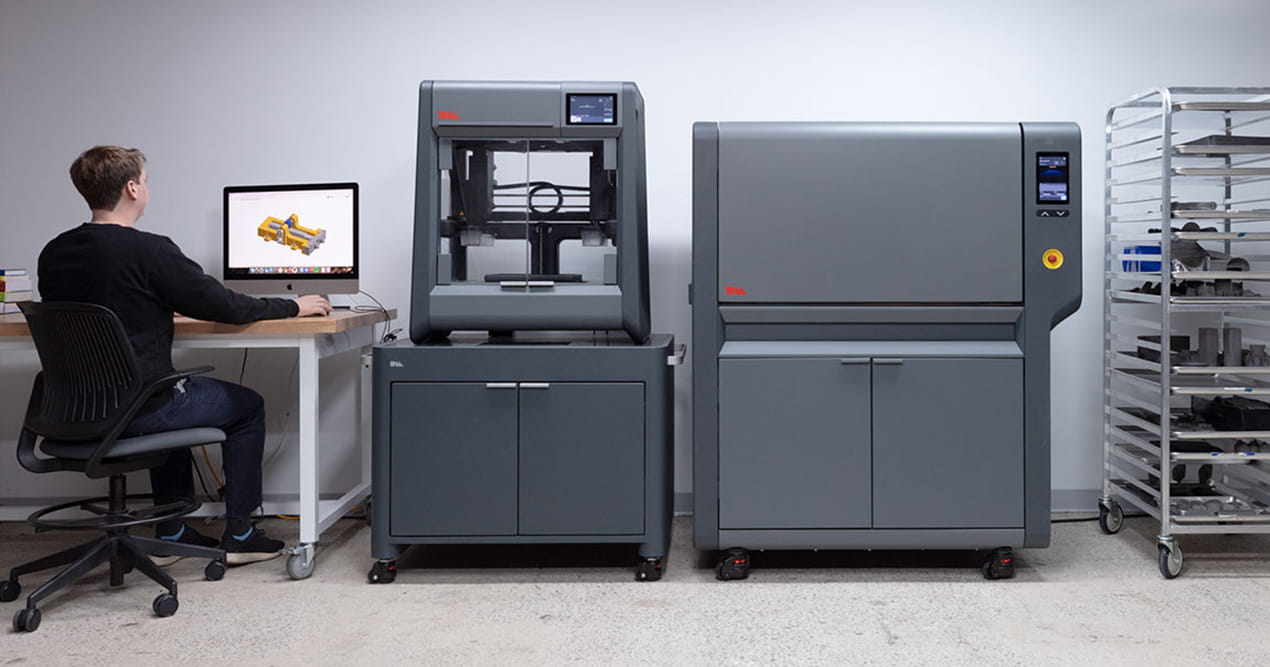
Metal 3D Printing in Vocational Training: The Arc Impact (formerly Desktop Metal) Studio System
Using Additive Manufacturing Safely and Practically in the Classroom
In recent years, additive manufacturing has become a key technology in modern industry. To ensure that students are optimally prepared for the demands of the workforce, relevant training content is becoming increasingly important at vocational schools as well.
The Desktop Metal Studio System provides educational institutions with a specially developed solution that integrates professional metal 3D printing into the classroom in a simple, safe, and hands-on way.
From a Digital Model to a Metal Component
The Studio System consists of a metal 3D printer and a sintering furnace. The production of a component takes place in two steps:
First, a so-called “green part” is additively manufactured. In this process, metal-filled rods—composed of metal powder and a binder—are extruded layer by layer. The process is similar to the well-known FFF 3D printing, which uses plastic filaments. By using metal rods instead of metal filaments, a significantly lower binder content is required, which has a positive effect on process reliability and component quality.
In the second step, the printed green part undergoes thermal debinding and sintering in a sintering furnace. During this process, the binder is removed and the metal particles bond together to form a dense, durable metal component.
Through this structured process, apprentices learn the essential steps of industrial additive metal manufacturing—from design to the finished workpiece.

A wide variety of materials for different applications
The Desktop Metal Studio System supports a wide range of materials relevant to industrial applications. These include:
- 17-4 PH Stainless Steel
- 316L Stainless Steel
- A2 Tool Steel
- D2 Tool Steel
- H13 Tool Steel
- Copper
- Titanium Ti64
- Inconel 625
- 4140 Steel

This allows for the practical teaching of a wide variety of applications in mechanical engineering, toolmaking, the automotive industry, and aerospace.
Security and easy integration into school environments
A key advantage of the Studio System is that it is suitable for use in offices and schools. Unlike many other metal 3D printing processes, users do not come into contact with loose metal powder at any point during the process. The metal powder is already securely bound in the binder and is processed in the form of metal rods.
This offers significant advantages, particularly in the field of education:
- High level of safety for students
- Easy to use for teachers
- Minimal infrastructure requirements
- Operates without the need for extensive renovations
- Smooth and hassle-free integration into everyday school life
This makes the system ideal for use in workshops, laboratories, and technical training centers.
Proven Technology in Research, Education, and Industry
The Studio System is already being used successfully by renowned research, educational, and industrial institutions. Users include, among others:
- BTU Cottbus
- Fraunhofer IAPT
- Carl-Schäfer School, Ludwigsburg
This widespread use underscores the technology’s practicality and high educational value.
Bringing Future Technologies to Life
The industry has a growing need for skilled workers who understand and can apply modern manufacturing processes. The Studio System gives vocational schools the opportunity to integrate innovative metal 3D printing technologies directly into their curriculum and prepare students for the demands of digitized production.
The combination of safety, ease of use, industrial relevance, and hands-on training makes the Studio System an attractive solution for educational institutions that want to permanently integrate additive manufacturing into their curricula.
Would you like to learn more about 3D metal printing in vocational training?
Then please feel free to Contact us—we’ll be happy to advise you personally.

Frederik Nussbaumer
Head of Sales
+49 172 4059105
frederik.nussbaumer@am-pioneers.com