

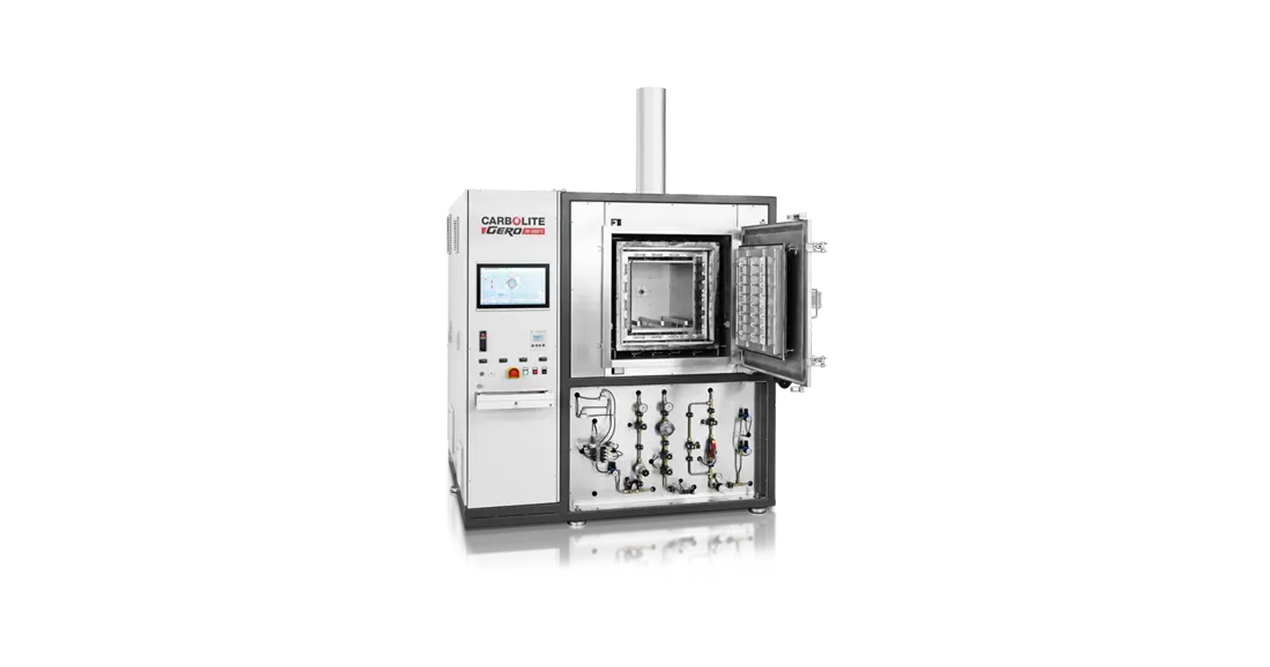
Sintering Furnaces in the Post-Processing Stage of Additive Manufacturing: The Step That Determines Quality
Anyone who thinks of additive manufacturing solely as “printing” overlooks a crucial part of the process: post-processing. Especially with binder jetting—a powder-bed-based process in which a binder is selectively applied to metal or ceramic powder—the initial result is merely a so-called “green part”: mechanically fragile, porous, and still far from possessing the final material properties. Only two subsequent heat treatment steps—debinding and sintering—transform the green part into a durable, dimensionally stable functional component. And this is exactly where Carbolite Gero comes into play.
From Green Part to Functional Component: Debinding and Sintering
After printing, the green part still contains the binder that held the powder particles together during the printing process. In the first furnace step—thermal debinding—this binder is removed in a controlled manner, typically in an inert gas atmosphere to prevent oxidation or unwanted reactions. In the second step—sintering—the component is densified at temperatures just below the material’s melting point: The powder particles fuse at their interfaces, the component shrinks in a controlled manner, and achieves its final density, strength, and dimensional accuracy.
Both steps are highly sensitive to temperature control, atmosphere, and furnace geometry. If heating is too rapid, cracks can form; an incorrect atmosphere leads to oxide layers or carbon absorption; uneven temperature distribution in the furnace chamber causes warpage. The demands placed on the furnaces used are correspondingly high.
Carbolite Gero: Specialist in debinding and sintering furnaces
Carbolite Gero specializes in precisely these indirect additive manufacturing steps and offers a tiered furnace portfolio for a wide range of requirements:
The GLO 8/13 is a compact entry-level furnace with a cylindrical retort (180 mm diameter) for temperatures up to 1,300 °C, operated with nitrogen, argon, or forming gas—suitable for thermal debinding, sintering, and pyrolysis in smaller batches or on a laboratory scale.
With usable volumes ranging from 8 to 320 liters, theHTK series accommodates significantly larger components and batches and, with molybdenum or tungsten insulation, reaches temperatures up to 2,200 °C—optionally under hydrogen, nitrogen, or argon atmospheres, or in low or high vacuum. This series is typically used for demanding metal and high-temperature ceramic applications.
For processes with particularly sensitive atmospheric requirements, the GPCMA (Modified Atmosphere Furnace), operating at 1,000 to 1,150 °C and with a volume of 37 to 245 liters, reduces the residual oxygen content to as low as 30 ppm—which is relevant, for example, for highly reactive alloys.

Why This Is Relevant for Binder Jetting Users
In addition to their traditional use in binder jetting, furnaces of this type are also used for stress-relief annealing following laser-based 3D metal printing—for example, with titanium alloys—as well as for vacuum heat treatment to controlled relieve internal stresses. Anyone seeking to establish additive manufacturing as a mass production process cannot ignore this process chain—choosing the right furnace is a key factor in determining scrap rates, part quality, and ultimately the cost-effectiveness of the entire production line.
Especially for those producing on an industrial scale, furnace selection should not be treated as an afterthought but considered from the outset as an integral part of process planning—including considerations regarding atmosphere, throughput, degree of automation, and maintenance requirements.
Cost-Effectiveness: Why Investing in the Right Furnace Pays Off
In many cost calculations for additive manufacturing lines, the furnace is viewed merely as an incidental expense—yet it directly influences two of the most important cost drivers: scrap and throughput. A furnace with insufficient temperature uniformity leads to warping and dimensional deviations that only become apparent after the sintering cycle is complete—that is, after material, energy, and machine time have already been invested. Conversely, a furnace tailored to the process—with the appropriate batch size and atmosphere control—enables multiple components to be processed reliably at the same time, thereby significantly reducing the cost per component.
The choice of atmosphere also plays a role in cost-effectiveness: Processes under hydrogen or vacuum tend to be more expensive to purchase and operate than those using nitrogen or argon atmospheres, but they often deliver better surface finish and purity values. Those who know their own component specifications can specifically choose the most cost-effective solution that still reliably achieves the required quality—rather than automatically opting for the most technically sophisticated option.
Buying a Sintering Furnace: What Matters
Anyone looking to buy a sintering furnace should first clarify their own process parameters: What material will be processed? What batch sizes and throughput rates are planned? What atmosphere and maximum temperature are required? Only on this basis can the right model be selected from the portfolio—ranging from compact entry-level furnaces to high-temperature vacuum solutions.
Conclusion
Additive manufacturing is often reduced to the printing process—yet it is frequently the post-processing that determines the success or failure of a part. With Carbolite Gero, AM Pioneers offers access to a furnace portfolio that scales from laboratory batches to industrial series production—tailored to the requirements of binder jetting processes as well as other additive metal and ceramic processes.
Are you planning the post-processing chain for your additive manufacturing and looking for the right sintering furnace? Talk to our team—we’ll advise you on furnace type, atmosphere, and process integration.
Source: Carbolite Gero, “Additive Manufacturing,” carbolite.com/applications/heating-applications/additive-manufacturing/ and am-pioneers.com/en/carbolite/ (accessed September 25, 2026).